The Grand Gathering concludes S+T+ARTS Hungry EcoCities—or did it?
How do you end a 3.5-year critical engagement, innovation escapade, intellectual journey, and social and cultural experiment through the food sector? After years of pursuit, with the finish line so close, do you simply part ways with one final digital exchange – a last emoticon blast, or do you muster the energy to connect, share, and live on in the spirit of those years by coming together and looking for next steps?
The Grand Gathering, as you can imagine, went for the latter.
In this article:
- How do we feed a city?
- The Grand Gathering Event in February 2026
- Carolyn Steel´s Keynote
- Workshops, Experiences & Installations
- The Mega Scale Menu: Scale as Pedagogy
- How the work ripples forward
- The projects on HECLab
How do we feed a city?
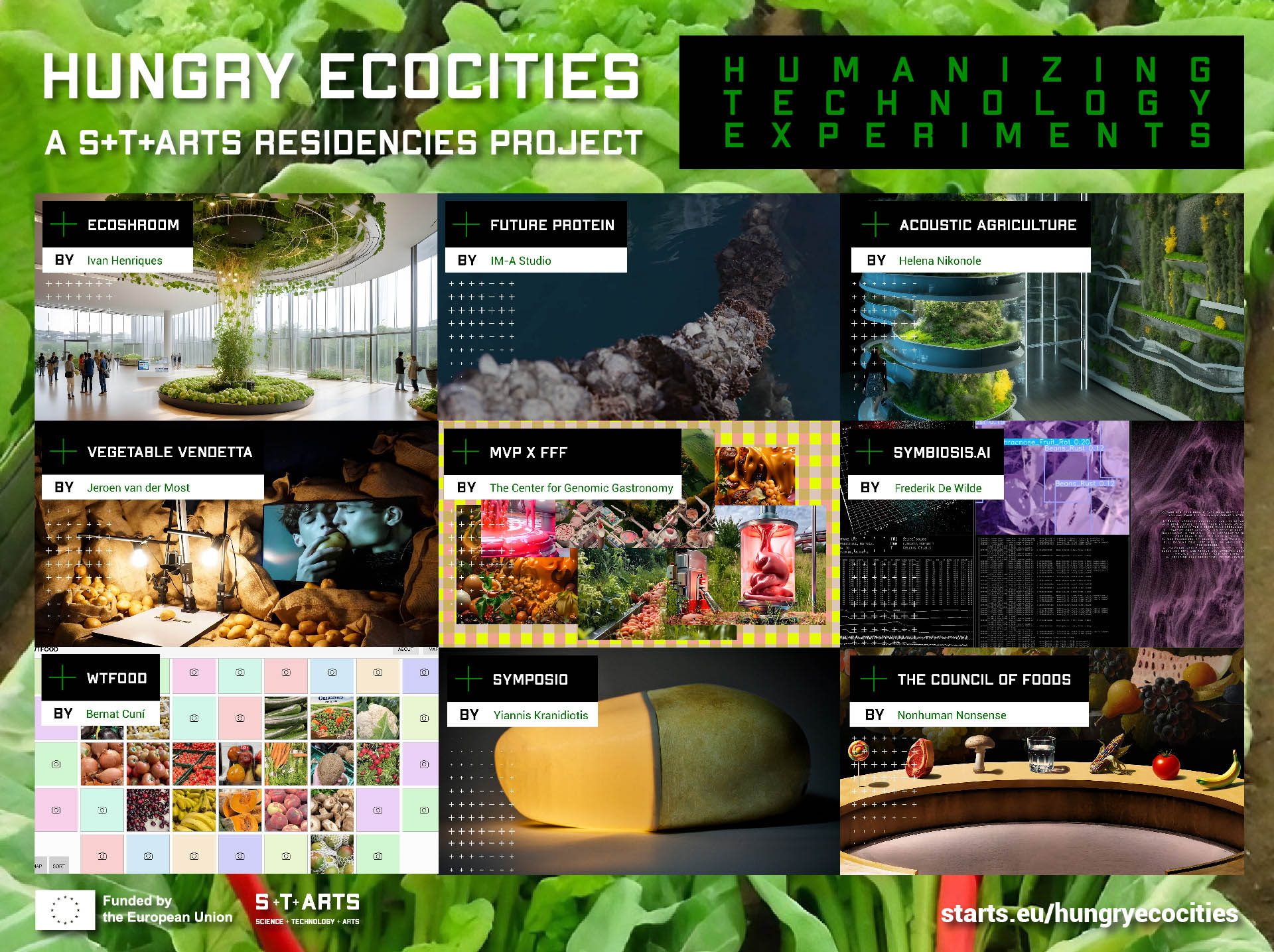
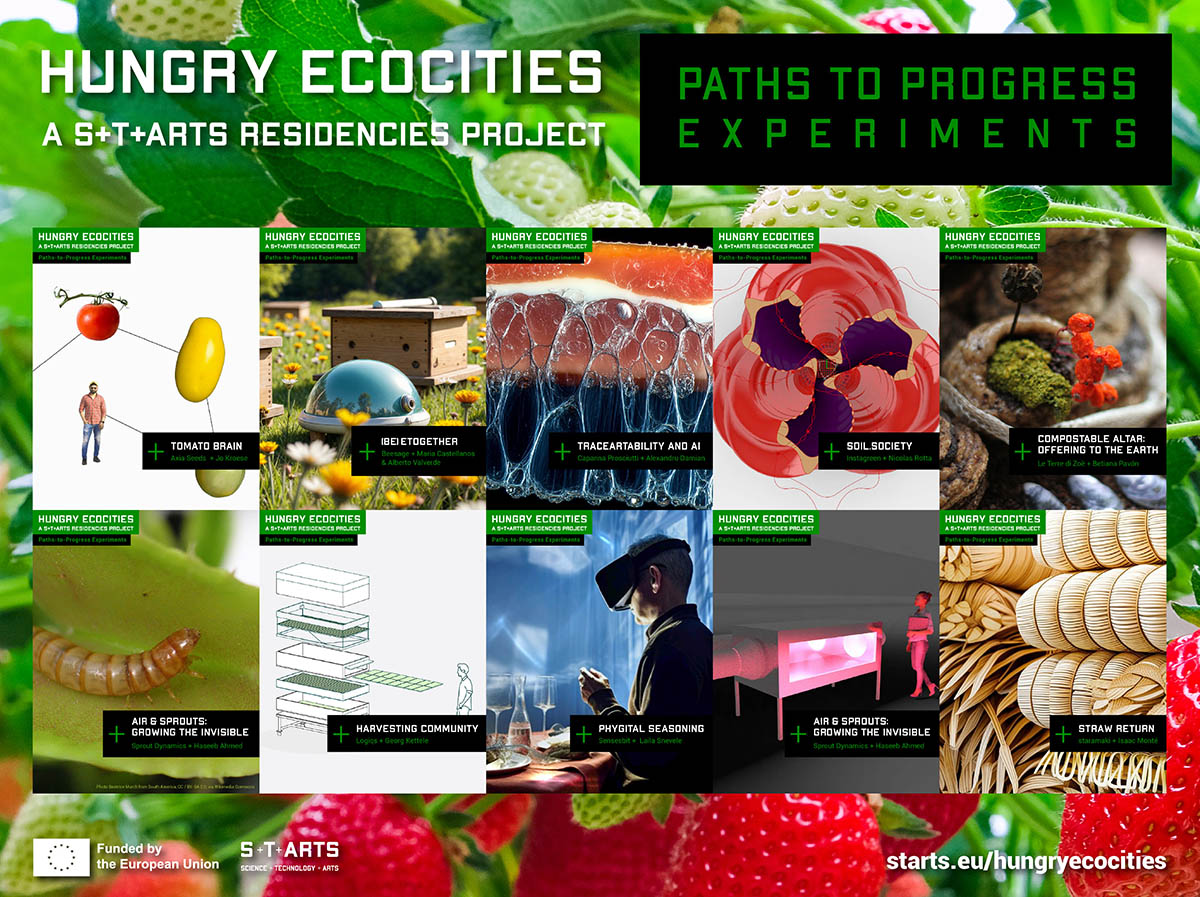
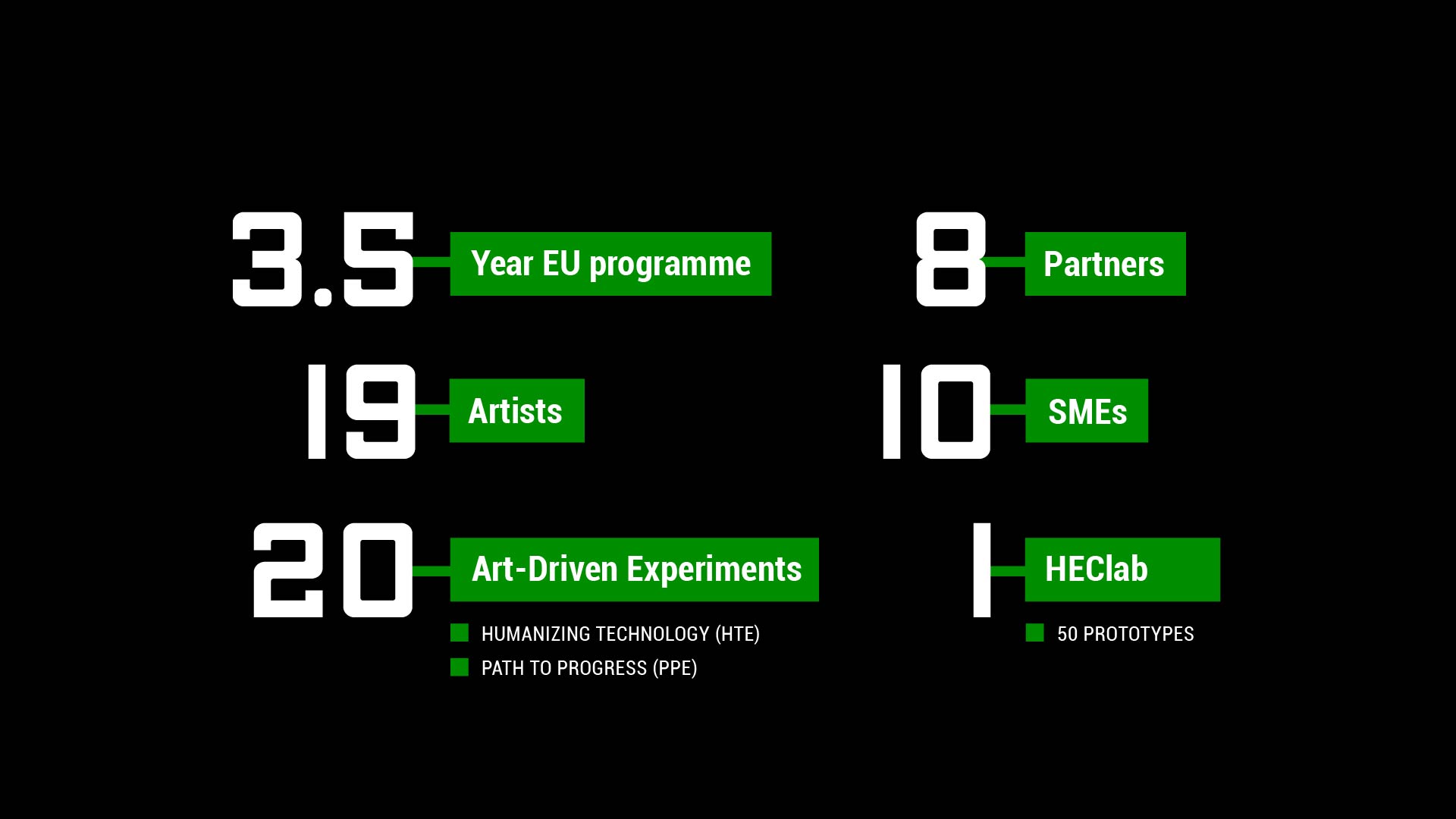
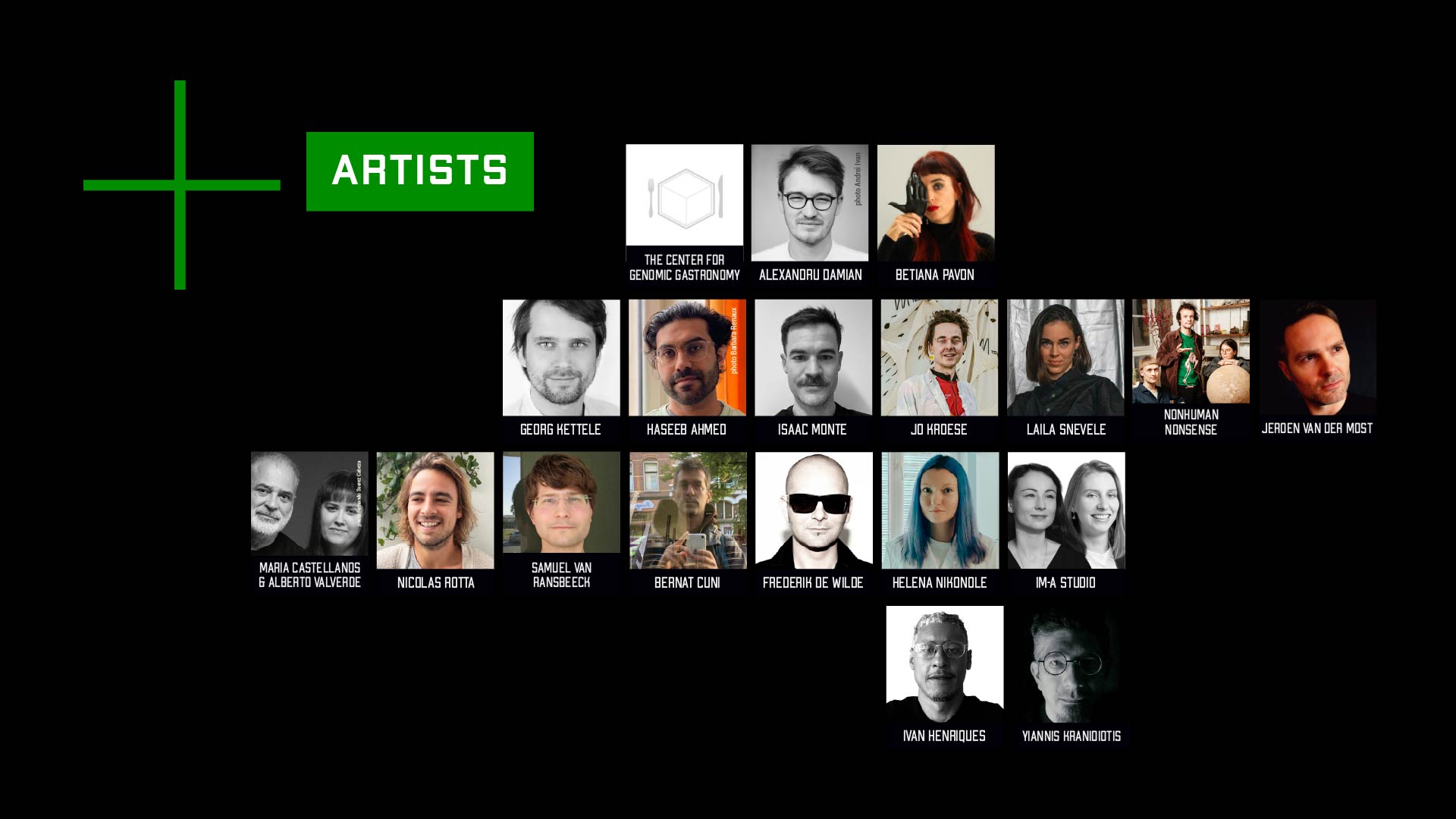
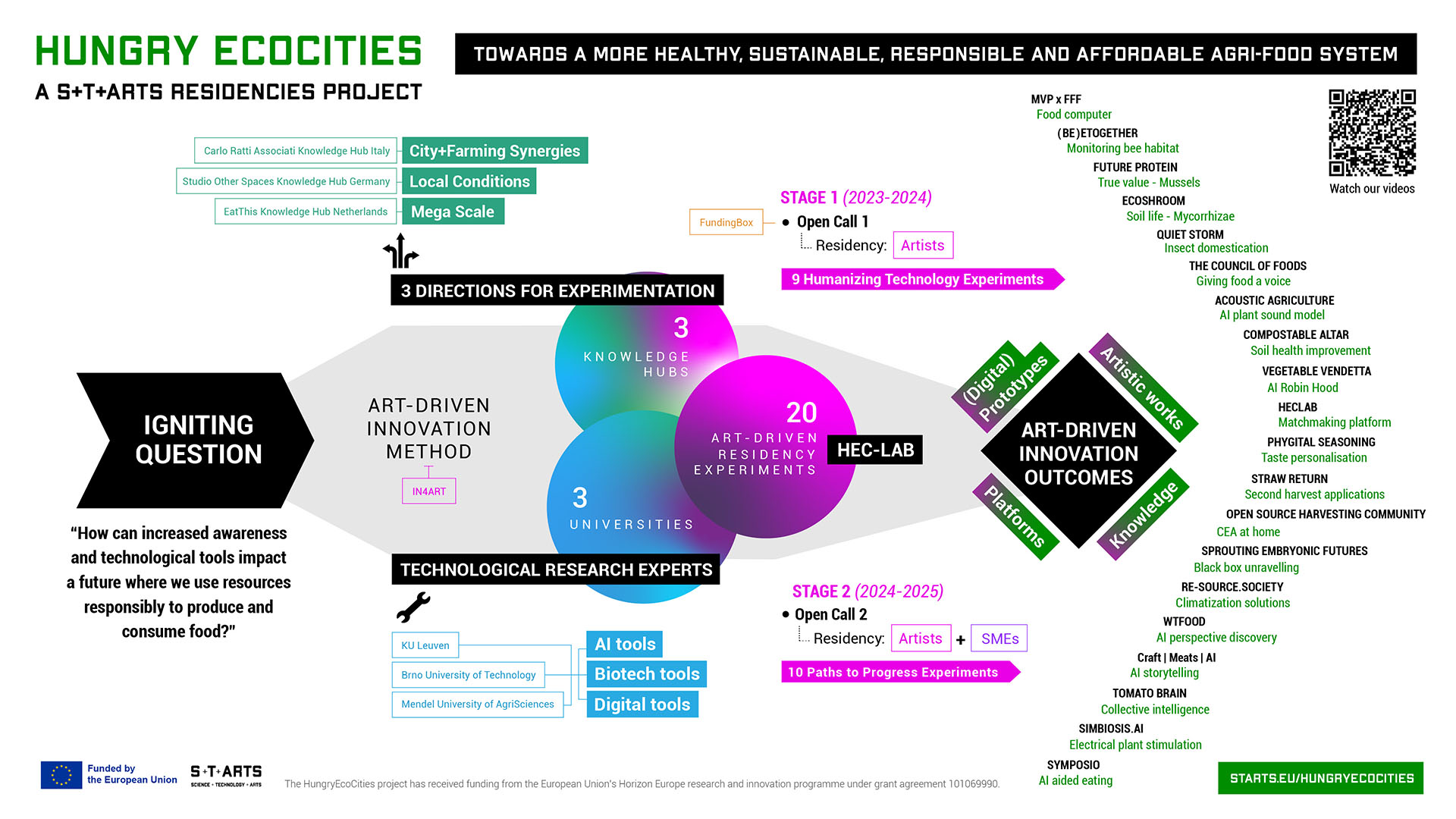
As part of the final steps, the Grand Gathering brought Hungry EcoCities full circle by returning to our departing question: how do we feed a city? Our approach to exploring this question and developing possible answers was based on building new ideas for future food systems through collaborative projects involving artists, scientists, creative thinkers, technologists, growers, agricultural specialists, and entrepreneurs. Digital technologies and artistic prototypes served as our tools; art-driven innovation was our method; and 19 S+T+ARTS residencies, divided over Humanizing Technology Experiments and Paths to Progress Experiments, became our pool of potential.
The Grand Gathering Event in February 2026
● Carolyn Steel´s Keynote
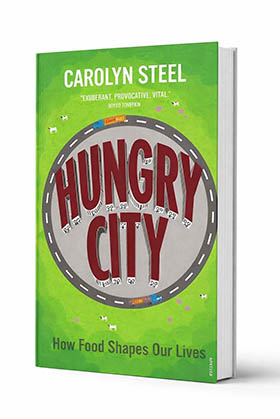
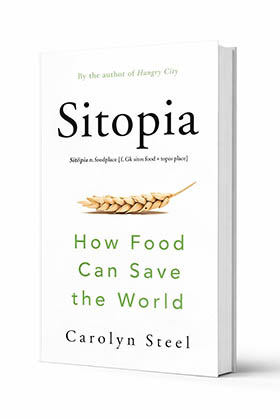
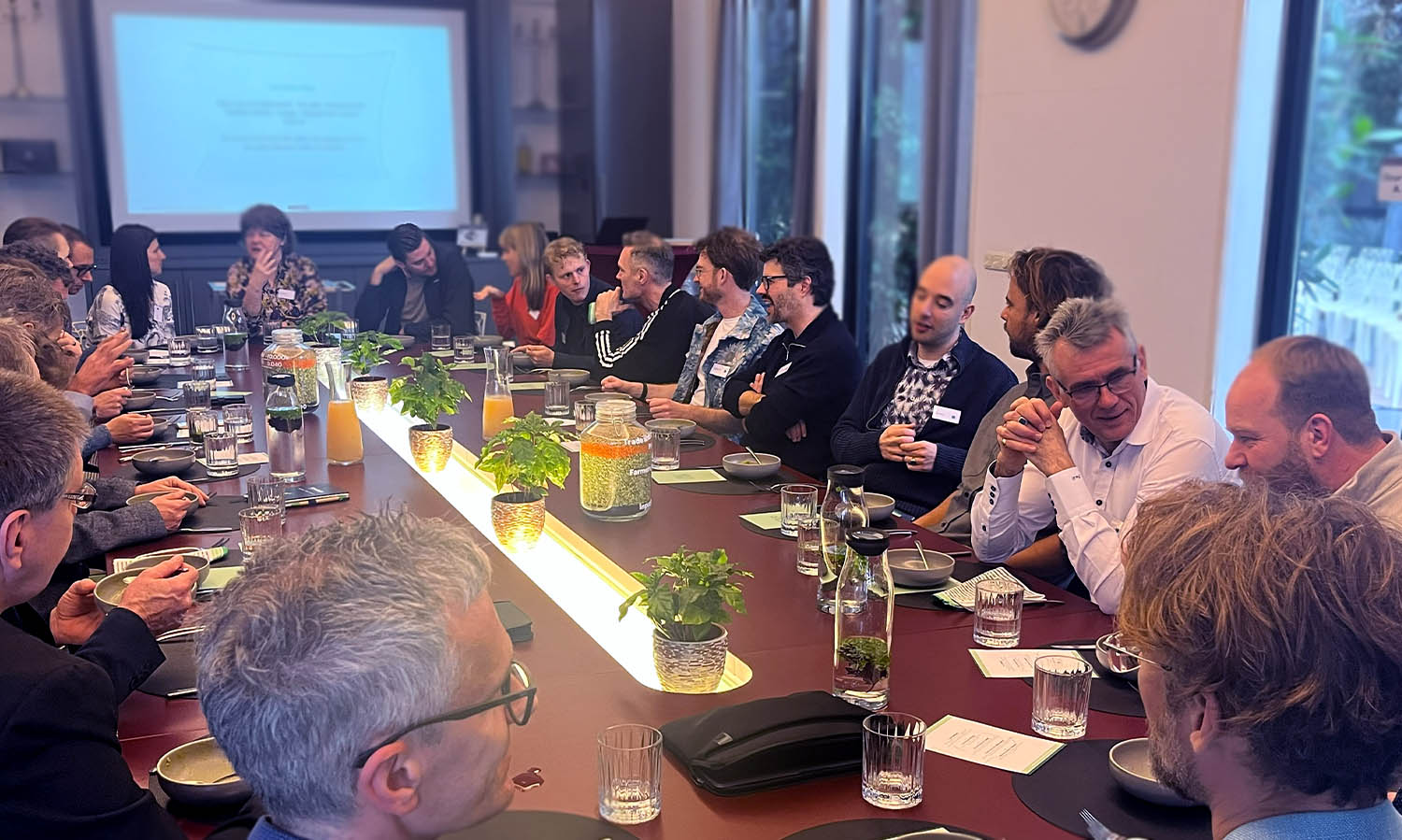
The Grand Gathering was hosted at Koppert Cress, the Westland-based company specializing in micro-greens. At the centre of the event was a lecture-cum-project reflection by architect and author Carolyn Steel. Her 2008 bestseller Hungry City was the main catalyst for the project’s intellectual framework and underpinning. Steel shared with an audience comprised of representatives from the food sector and the consortium how food had been essential to the creation of cities and society at large. She traced its development through time and showed how it had transformed into the overwhelmingly complicated, unsustainable system we know today.
Carolyn Steel reminded us that:
- The size and structure of cities have always been determined by food and transport.
- Modern urban life has distanced people from their food.
- Industrial food systems hide environmental and social costs.
- Crises often reconnect people to local food and community.
“Everything, literally everything, can be brought back to food.
Food is our existence.” Steel reflected.
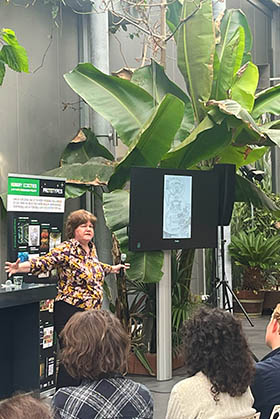
Steel revisited several HEC prototypes and explored their meaning with the audience, connecting intellectual insight to tangible innovation. From the Be(e)Together prototype by Maria Castellanos and Alberto Valverdo, which improves communication between bees and beekeepers, to Ecoshroom by Ivan Henriques, examining the importance of mycorrhizal fungi, to the exploration of Parma ham-making craft alongside AI with Alexandru Damian and Capanna Prosciutti in Crafts / Meats / AI, each prototype embodied for her our central question: how can art, design, and technology reshape food systems?
“I was thrilled to discover that Hungry City had been the inspiration for such an ambitious pan-European project, and it was fascinating to see what one might call the sitopian question – not merely that of how we can all eat well and sustainably in the future, but of how, by valuing food and putting it at the heart of our thinking, we can lead better lives – explored jointly through the worlds of art and AI. At the heart of the sitopian idea is the realisation that food sits at the nexus of our two most vital sets of relationships, with nature and with one another. Some of the projects really managed to pull all these things together in a very inspiring way, and I think this integrated approach, with food at its core, has a lot of potential for future development. ” Carolyn Steel
Re-listen/watch Carolyn´s keynote:
● Workshops, Experiences & Installations
Preceding the talks, there were 3 workshops that focused particularly on the role of AI in reshaping food sector collaboration.
■ The Tomatobrain (further developed into SuperMind) by Jo Kroese for Axia demonstrated how intelligent systems can facilitate real-time knowledge gathering and sharing.
■ Similarly, Nicolas Rotta and Instagreen from the Re.Souce Society experiments; showed how merging low-tech observation creates practical value;
■ whilst Jeroen van de Most’s Vegetable Vendetta illustrated how emerging technologies are democratising marketing opportunities for SMEs in the food space.
□ As an experience, all present got to experience the Phygital Seasoning future of taste during the final drinks and tour through the edible jungle.
Valentina Gritti experiencing the Phygital Seasoning installation for the CleverFood podcast, with a dedicated episode to Hungry EcoCities “Cities that grow: framing the urban future with AI, art and nature”, listen to the podcast –>
● The Mega Scale Menu: Scale as Pedagogy
At the start of the programme, we had set out to create three visions to understand complex food challenges, addressing themes such as regenerative agriculture, vertical farming, alternative proteins, and multispecies relations.
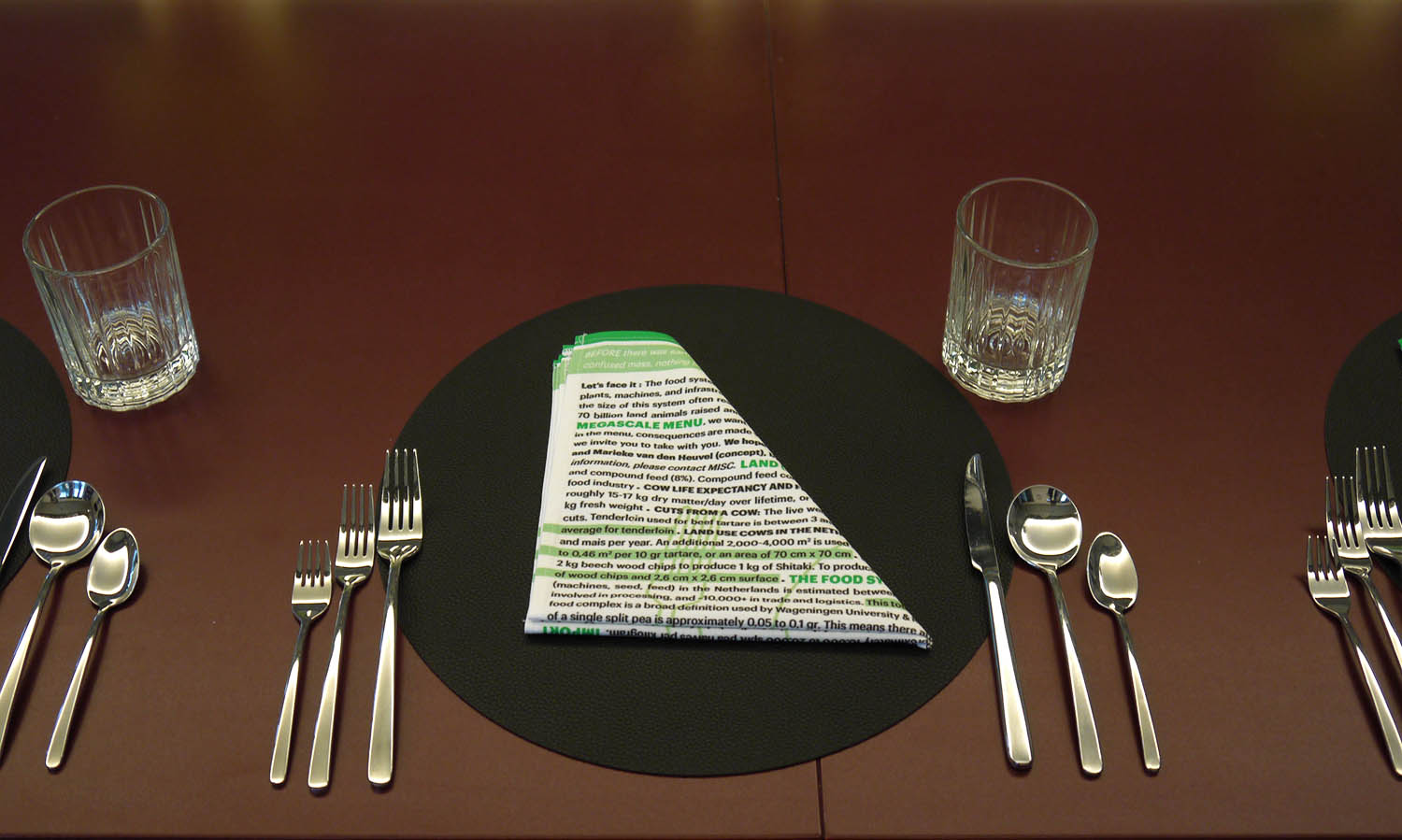
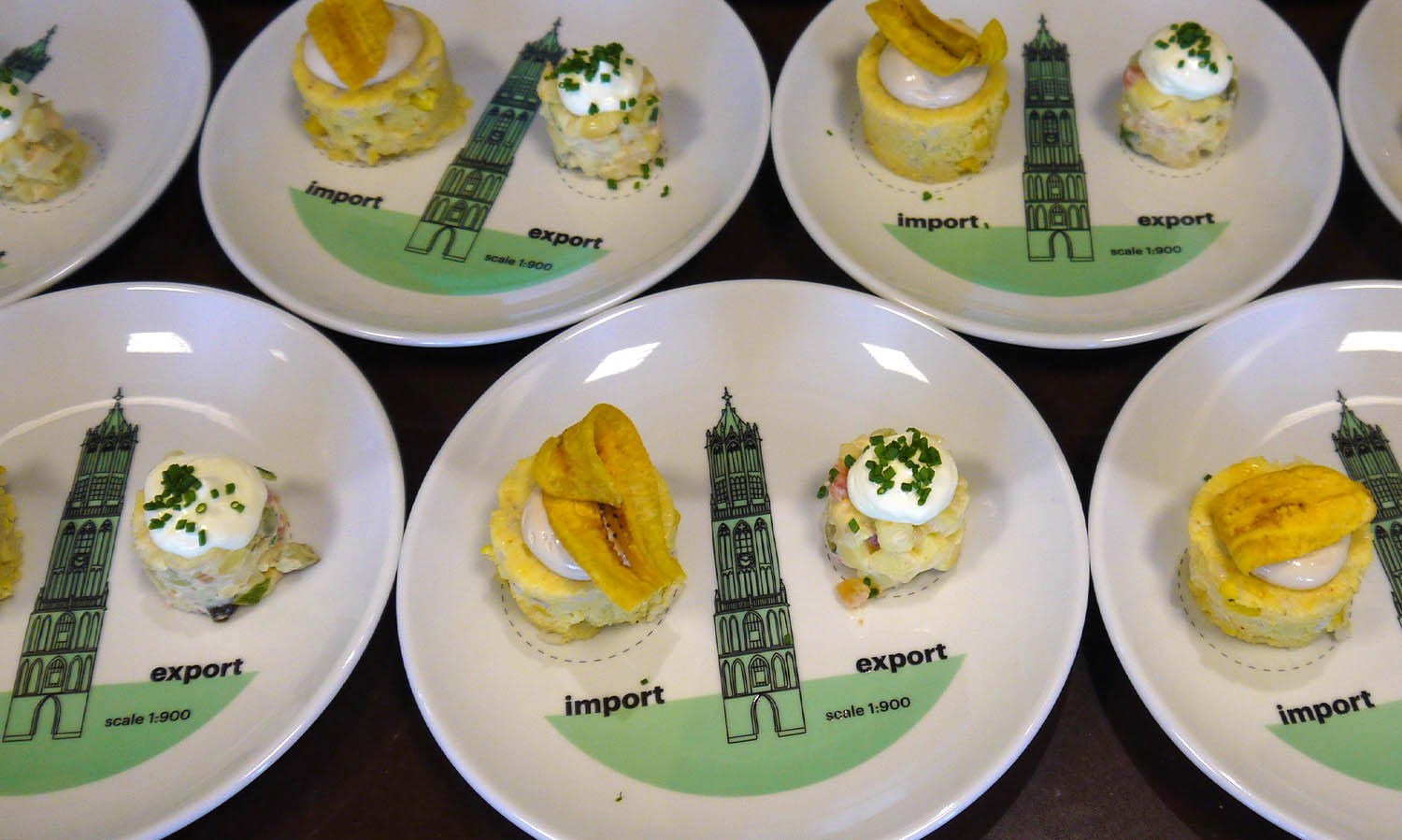
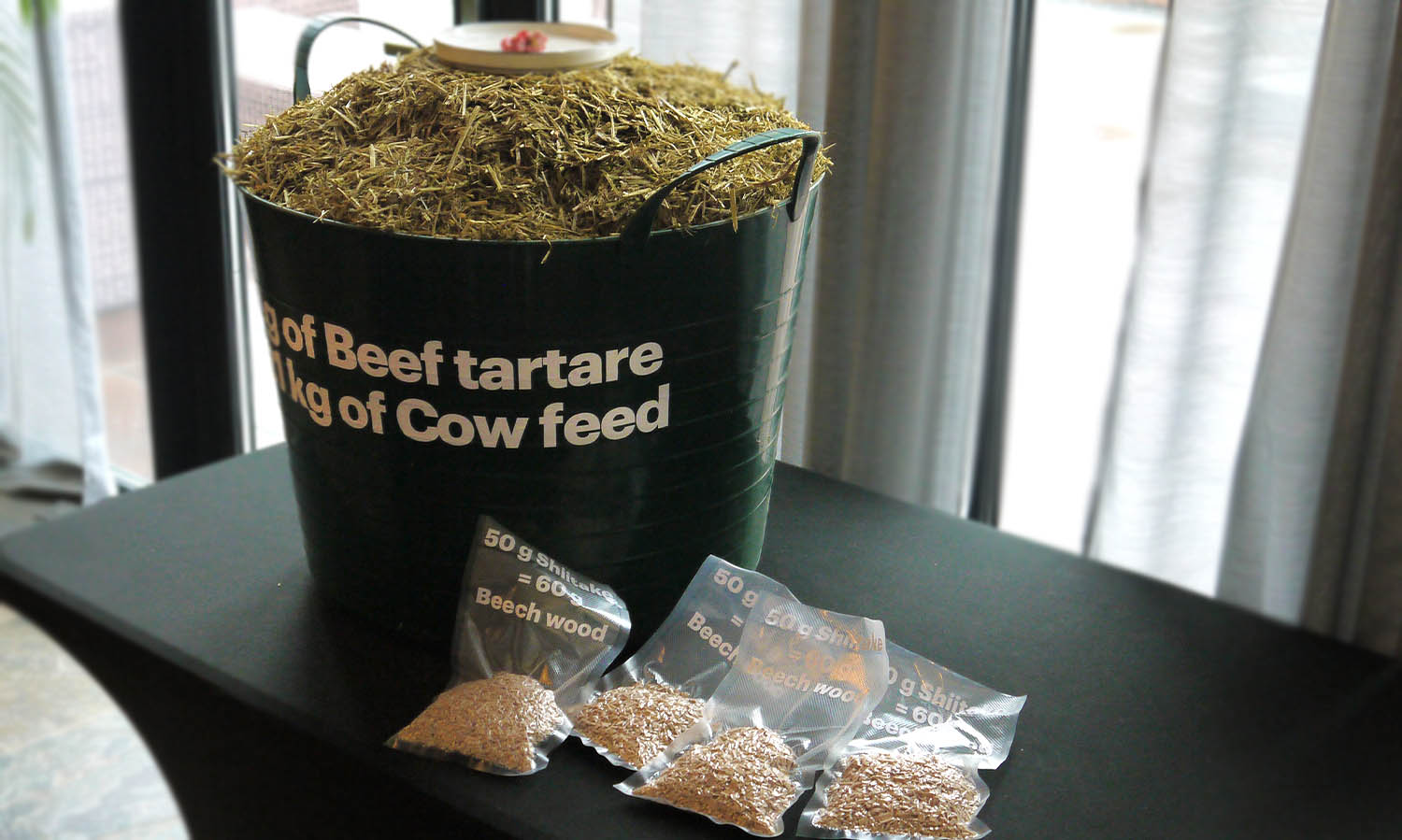
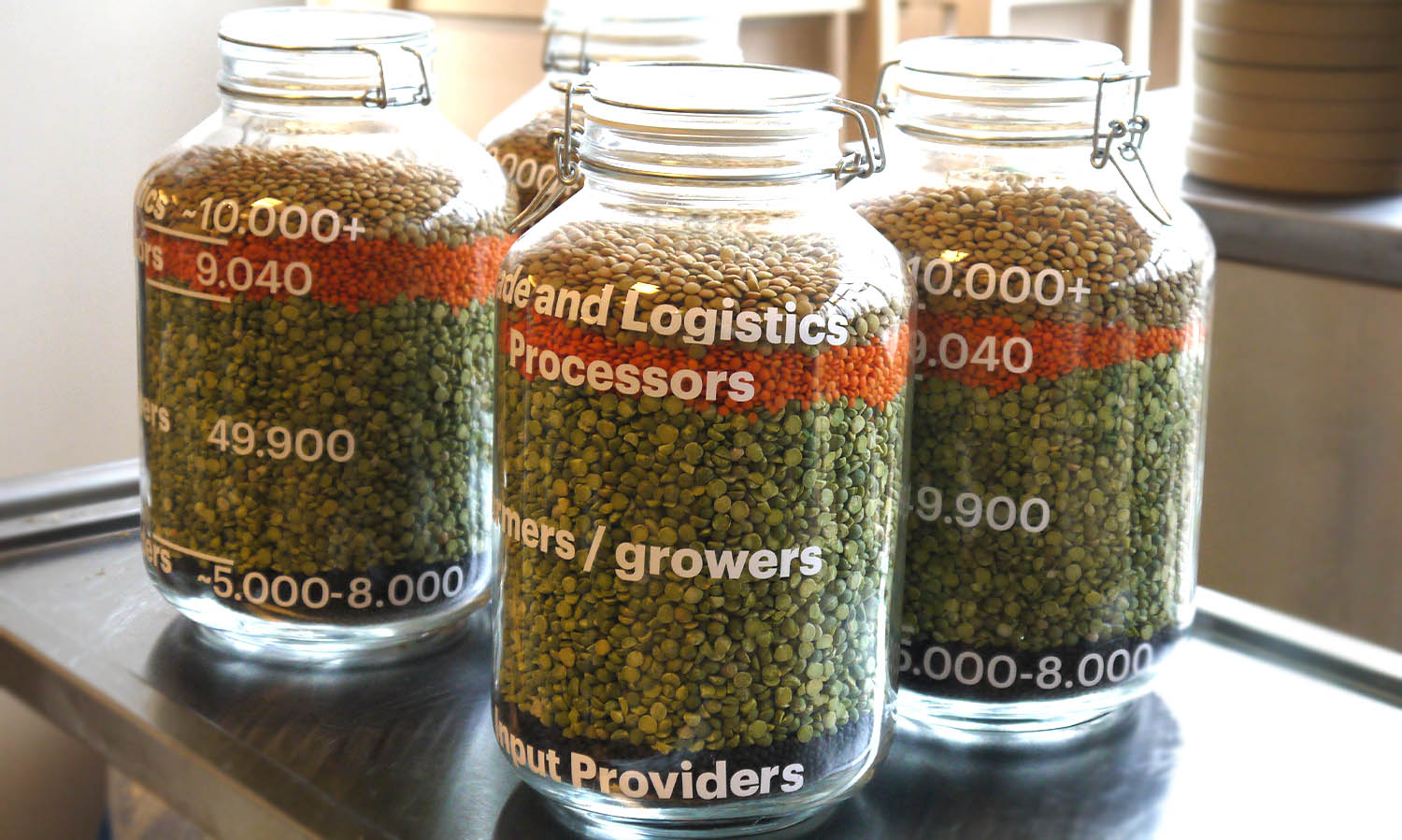
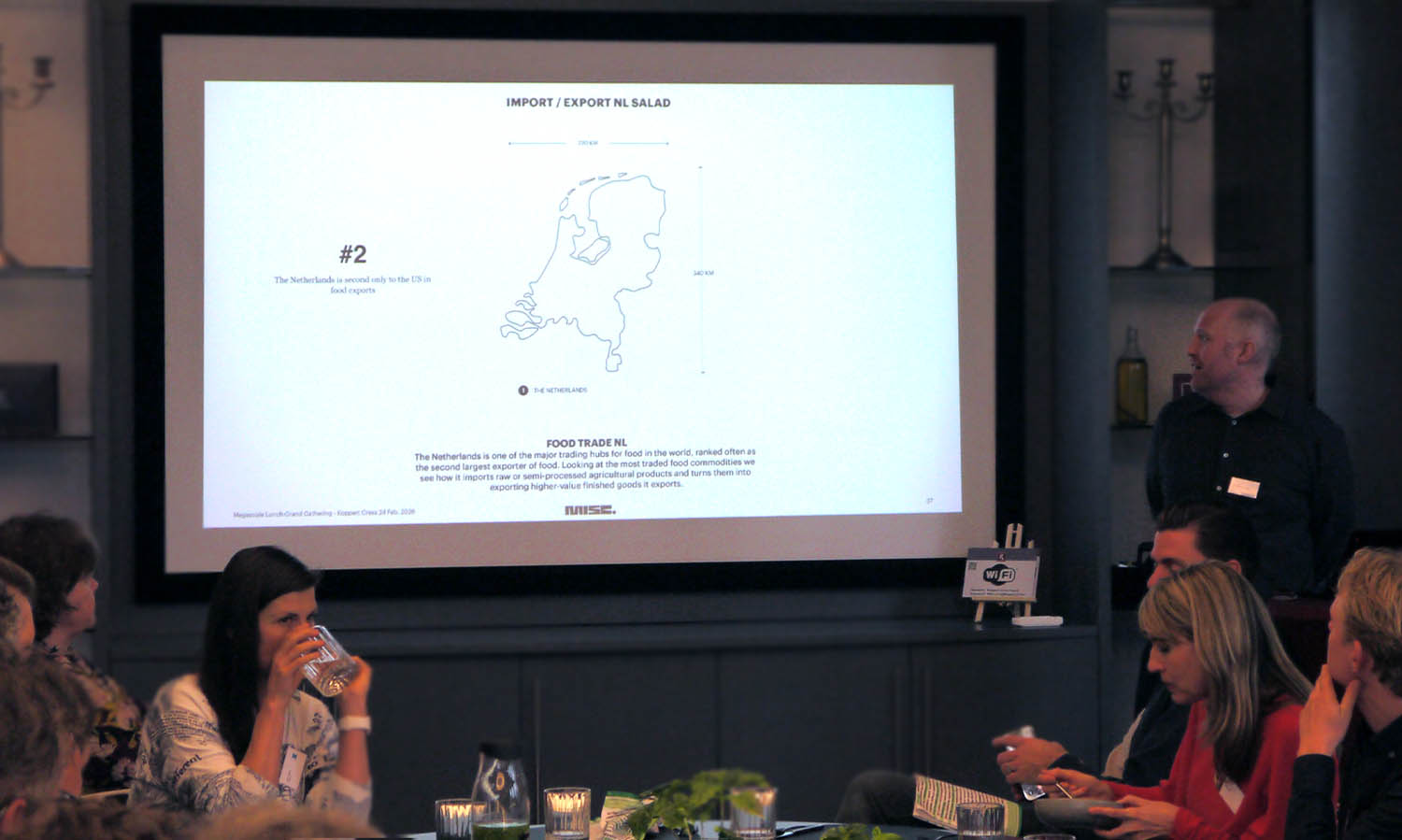
The Mega Scale direction was one such exploration, proposed by Eatthis, and it was revisited for the final event in the shape of a special lunch menu composed in collaboration with chef Arvid Schmidt. Taking scale—arguably the true essence of the architectural profession—to heart, the menu featured a number of dishes that showcased the scale of the food sector in one of Europe’s most important food hubs: the Netherlands.
■ THE MENU ■
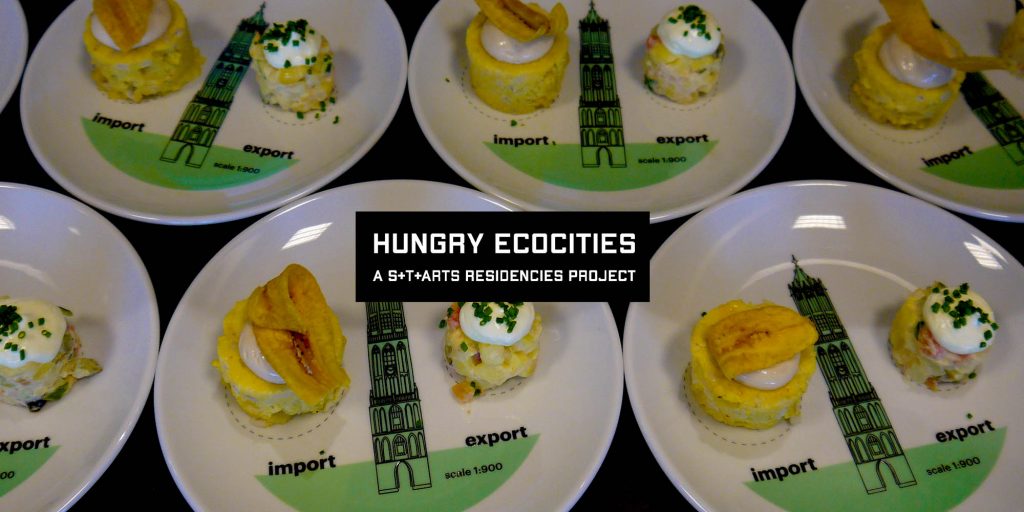
Drawing from statistics, there was a “Land (am)use” dish that literally showed the amount of inputs needed to create two small dishes: 12g of tartare served with a representation of the 28 kilograms of grass feed the cow consumed to provide that same amount of meat, compared to a delicate shiitake dish, which used only 1/100 of that land. Following dishes looked at export and import, CO2 emissions, and the scale of the sector itself.
The lunch concluded with a distributed dessert: an apple dish served as individual that could only be turned into a complete dish by sharing with others. A deliberate gesture inviting guests to experience interdependence, which we assume will carry on moving forward.
How the work ripples forward
After 3.5 years of collaborative work, Hungry EcoCities has generated substantial tangible and intellectual outcomes. The project produced 19 innovative technological ideas and 7 new material concepts, prototypes to envision, build, and realise alternative food systems. These innovations have been complemented by academic output: one PhD research project, two master´s theses, over 15 bachelor´s, master´s, and MBA course cases, and (to date) three peer-reviewed scientific publications.
Yet the true measure of success extends beyond outputs. The work has fostered a significant shift in how technologists and artists understand food systems together—moving from purely computational solutions towards what we call humanised applications of e.g. advanced machine learning. Examples include computer vision methods for bee-hive monitoring, which have demonstrated potential for creating additional ecological impact, as well as new interdisciplinary research collaborations that would not have emerged within traditional disciplinary silos.
To ensure broad accessibility and knowledge-sharing, we documented the entire journey comprehensively. Twenty project videos are viewable through the S+T+ARTS Hungry EcoCities YouTube playlist, and the prototype overview is accessible through the HEClab.
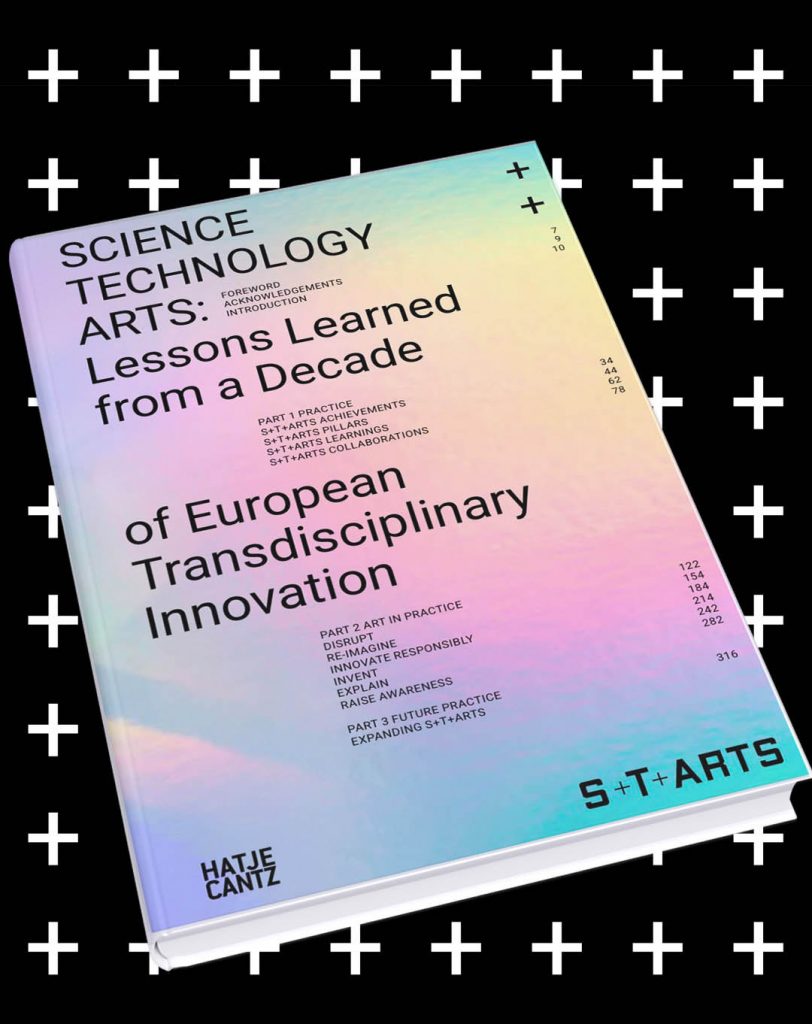
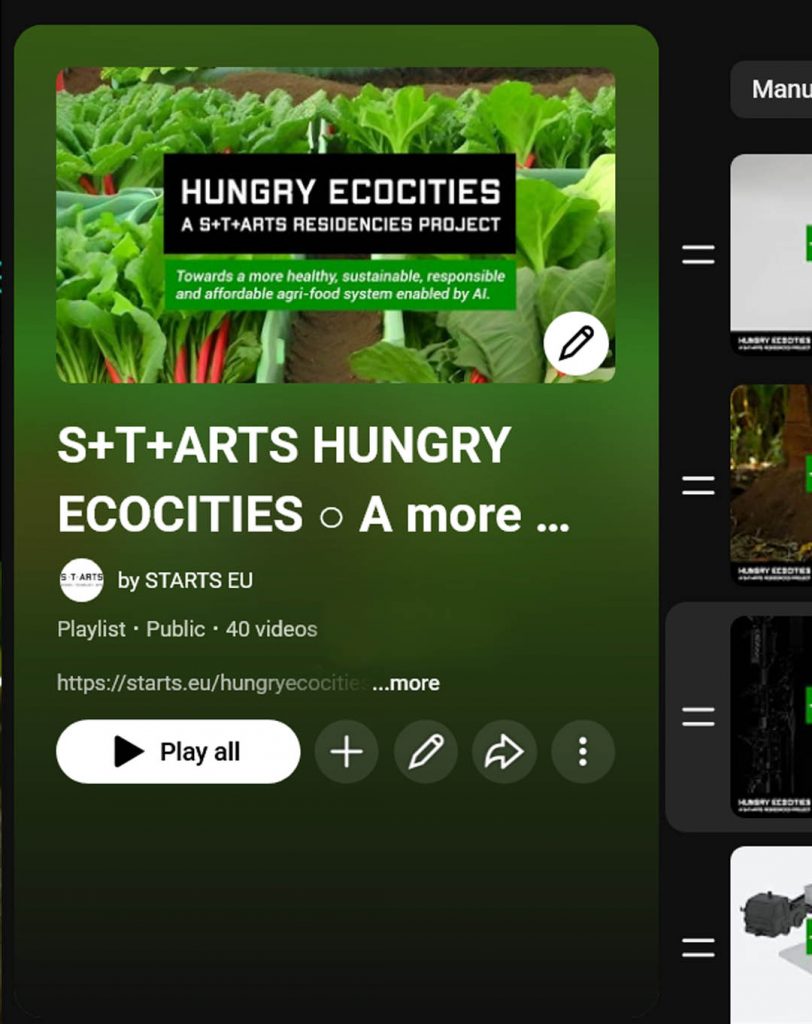
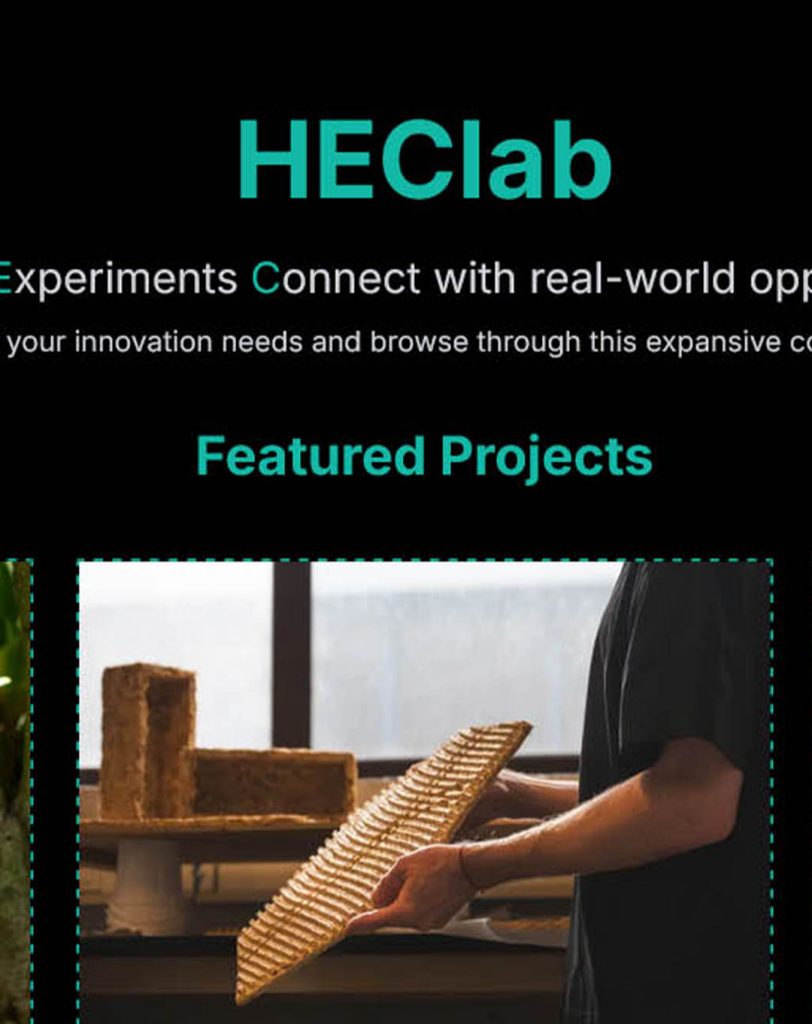
Both serve as starting points for those wishing to build on this work. Additional video material, including a synthesis documentary, Innovating the Agri-Food System Through Art, Design and Technology, is available in the same playlist. Next to that, results have also been featured in the 10 Years of S+T+ARTS book, Lessons Learned from a Decade of European Transdisciplinary Innovation.
Throughout the programme, a crucial learning emerged: interactive prototype demonstration events matter profoundly. The Grand Gathering embodied this principle. By creating spaces where stakeholders could experience work multi-sensorially, through the Mega Scale lunch, hands-on workshops, and direct encounters with prototypes, we ensured that knowledge remained connected to bodies, senses, and real decisions. This is no small thing in a sector often dominated by static presentations, abstract policy and distant supply chains.
The reach of the project extended far beyond the directly involved participants. If we would draw the ecosystem involved in the project, it would span to over 125 additional professionals that collaborated with the Hungry EcoCities framework, ranging from curators, technologists/ creative developers, scientists/educators, (food) industry experts, policy, educators and culinary experts. Work was brought to the wider audience through our demonstration events and written interviews, podcasts, and television appearances on Spanish national broadcaster TVE (Quiet Storm and Be(e)Together) and Euronews (Vegetable Vendetta). Solo exhibitions for Vegetable Vendetta (Estonia), Be(e)Together (Burgos), Phygital Seasoning (Mediamatic), Ecoshroom (Zone2Source), Straw Return (Kazerne Eindhoven), and Compostable Altar (Disseny Barcelona) have travelled the European landscape, embedding the work within diverse cultural contexts.
Hungry EcoCities ends here, but the ecosystem it has nurtured does not. The question “How do we feed a city?” remains as urgent as ever. It is now enriched by the artists, technologists, scientists, food sector leaders, growers, and thinkers who have touched this works in Hungry EcoCities and carried it forward into their own practice. That is how a project truly concludes: not with an ending, but with new beginnings.
The projects on HECLab
HEClab is continuously open to new artistic prototypes.
Hydroponic boxes equipped with vibrational speakers, custom electronics, sensors and an AI sound model to redefine how we think about AI, noise pollution, and the biosemiotic relationship between sound and plant life.
An interactive website built to create a space to discuss the food system with food representing AI avatars.
A hardware interface and AI model trained with mycorrhizae on plant symbiotic communication effects.
A remote-sensing model that predicts the development of mussel farming and shows its potential in terms of nutrition and ecological value.
An AI-assisted thinking and tinkering tool for harmonizing the rhythms and culinary (& nutritional) possibilities of Food Forest Flavours and Alternative Proteins (Commercially available, non-animal derived high-protein food products a.k.a. Minimum Viable Proteins (MVPs)).
A data set on effects in nutrition uptake in plants through electrical stimulation.
A table device that aims to enhance our dining experience and promote healthier eating habits by reducing automatic or mindless eating with the use of light and AI.
An installation that empowers marketing skills for vegetables through gen AI created content.
A lens based AI module to uncover the glitches of the food system, explore various systemic socioeconomic perspectives and discover ways to take action.
1. (Be)etogether Interface: transforms internal hive data into a sensory experience: light, sound, vibration, and airflow that allow you to “feel” the life of the bees from within.
2. (Be)etogether set of sensors: the kit captures temperature, humidity, vibrations, sounds, bee movements, and air quality, along with periodic images of the hive environment. Thanks to this network of sensors and AI processing, behavioral patterns, hive health, and anticipated nectar flows can be monitored.
3. Community Varroa Monitoring Tool: AI image recognition to automatically detect and count varroa mites from photos of monitoring boards — making hive health assessment faster, more accurate, and less invasive.
Compostable Altar: offering to the earth: recipes and process to transform agricultural waste into biodegradable, data-driven sculptures that enhance the soil quality. Combining biomaterial research, digital fabrication, and AI, it celebrates circularity and reimagines design as a living, regenerative process.
Combining scientific imaging, AI storytelling, and salt-based printing to reveal how salt, air, and patience transform raw meat into Prosciutto di Parma.
OPEN SOURCE HARVESTING COMMUNITY
1. openCEM Spider: a coreXY tool plotter which can printed once and scaled to any dimension with standard profiles.
2. openCEM – controlled environment grow unit: a open source framework for growing plants in a controlled environment.
Phygital Seasoning AR set-up redefines taste as a designed experience of perception, not ingredients.
Quiet Storm – Music for Insects a curated sound set-up to enhance the mating process of the Tenebrio Molitor beetle, population reproduction, and to cultivate empathy.
1. Re-Source.Society prototypes mix of Cooling Cactus, Living Lung and Basic Brain: explores how materials can regulate climate using natural physics instead of energy-intensive machinery.
2. Fair-advantage.org: an AI-powered search tool that democratizes marketing and sales efforts of small, local, sustainable food producers.
Sprouting Embryonic Futures Sprouter: a living system that combines sensor networks, a stroboscopic watering system, and an automated timelapse machine to grow and visualize sprouts in real time.
A process to turn wheat stem residues into high-value materials for design and interiors.
A multi-agent AI system to support human collective intelligence.

The HungryEcoCities project has received funding from the European Union’s Horizon Europe research and innovation programme under grant agreement 101069990.