Cover Picture © Peace Olatunji

Read:
Afropean Intelligence Symposium:
The Archive is Alive.
We often think of archives as static, rooms full of yellow-brown papers and objects that many may believe are outdated and useless. The ten artists who completed the S+T+ARTS Afropean Intelligence residency programme have proven to us the contrary: the archive is alive and has the capacity to shape our work and worlds. By merging Indigenous knowledge and art, partly using AI in their projects, they have created pieces of art with the capacity to move an audience and bridge times and spaces, projecting us into the future utilising objects and memories of the past.
What happens when we stop treating archives as storage spaces of the past and begin understanding them as infrastructures for the future?
(This question echoed throughout the S+T+ARTS Afropean Intelligence Symposium, held at the AfricaMuseum in Tervuren on 28 May 2026. Bringing together artists, researchers, technologists, cultural practitioners and policymakers, the event marked the near-end of the Afropean Intelligence programme while opening new conversations about the relationships between memory, technology, community and knowledge production. The programme spanned over the course of eighteen months, offering ten artists 8-month residencies in five different countries in Africa: Nigeria, Egypt, Tunisia, South Africa and the Democratic Republic of Congo. They were invited to develop art projects that spoke to local challenges and contexts of their choice, with the aim of engaging the preservation of cultural heritage with the critical exploration and use of AI. S+T+ARTS Afropean Intelligence also awarded six artistic projects through the renowned “S+T+ARTS PRIZE AFRICA” and developed a series of Online Expert Talks and Podcasts to reflect on the challenges of artistic creation and new technologies.
This article was written by Sari Hellara Hernandez (Vrije Universiteit – Amsterdam), as part of the S+T+ARTS Afropean Intelligence Symposium, in May 2026.

Across debates, performances, one keynote and artistic presentations, a recurring question also resonated: how can African and Afro-descendent artists use AI to engage with the archives made available to them in order to create art that not only speaks to them but also reflects issues of our time?
The artists have demonstrated that archives are living systems of relationships: they preserve histories, but they also generate futures. They are sites of memory, but equally of imagination, resistance and transformation. Futurity, transformation and (re)imagination are exactly the axes in which AI was introduced into the artists’ projects – taking the form of a tool for resistance.
Revisiting archives, (…), requires more than cataloguing collections; it demands reconnecting objects with the people and contexts in which they are rooted.
In a moment when artificial intelligence increasingly shapes how knowledge is organised, accessed and valued, the symposium challenged dominant technological paradigms by highlighting and valuing Indigenous knowledge systems, community-led archives and situated forms of intelligence. Rather than asking how communities can adapt to technological innovation, participants explored how technologies themselves might be transformed through ecological knowledge, territorial practices and Indigenous ontologies.
The day opened with reflections on the archive as a dynamic and evolving entity. Rather than viewing archives as neutral institutions preserving objective truths, speakers emphasised their political, subjective and unfinished nature. Naomi Meulemans, Head of Cultural Heritage Collections at AfricaMuseum, proposed a reframing and reshaping of the archive. While institutions may preserve objects, the knowledge that gives those objects meaning often remains elsewhere, specifically in communities, practices, stories and relationships. For generations, many African communities were treated as subjects of research rather than active participants in the production and interpretation of knowledge. Several speakers addressed the colonial violence embedded within many cultural institutions and collections. One recurring theme was access; not simply physical access to collections, but the ability to establish meaningful relationships with cultural objects and ontologies. Throughout the symposium, participants argued that people do not need to possess an object for it to contribute to their sense of identity. They do, however, need opportunities to encounter it, study it and reconnect with its stories. Revisiting archives, therefore, requires more than cataloguing collections; it demands reconnecting objects with the people and contexts in which they are rooted. This perspective challenged conventional assumptions about ownership and preservation. An archive, participants suggested, is never complete but is like a living organism: it grows, changes and accumulates new meanings over time. It engages and is engaged with. To quote Naomi Meuleman: “The archive is not a cemetery. It can be a conversation, if we allow it to be.”
Revisiting archives, (…), requires more than cataloguing collections; it demands reconnecting objects with the people and contexts in which they are rooted.
In a moment when artificial intelligence increasingly shapes how knowledge is organised, accessed and valued, the symposium challenged dominant technological paradigms by highlighting and valuing Indigenous knowledge systems, community-led archives and situated forms of intelligence. Rather than asking how communities can adapt to technological innovation, participants explored how technologies themselves might be transformed through ecological knowledge, territorial practices and Indigenous ontologies.
The day opened with reflections on the archive as a dynamic and evolving entity. Rather than viewing archives as neutral institutions preserving objective truths, speakers emphasised their political, subjective and unfinished nature. Naomi Meulemans, Head of Cultural Heritage Collections at AfricaMuseum, proposed a reframing and reshaping of the archive. While institutions may preserve objects, the knowledge that gives those objects meaning often remains elsewhere, specifically in communities, practices, stories and relationships. For generations, many African communities were treated as subjects of research rather than active participants in the production and interpretation of knowledge. Several speakers addressed the colonial violence embedded within many cultural institutions and collections. One recurring theme was access; not simply physical access to collections, but the ability to establish meaningful relationships with cultural objects and ontologies. Throughout the symposium, participants argued that people do not need to possess an object for it to contribute to their sense of identity. They do, however, need opportunities to encounter it, study it and reconnect with its stories. Revisiting archives, therefore, requires more than cataloguing collections; it demands reconnecting objects with the people and contexts in which they are rooted. This perspective challenged conventional assumptions about ownership and preservation. An archive, participants suggested, is never complete but is like a living organism: it grows, changes and accumulates new meanings over time. It engages and is engaged with. To quote Naomi Meuleman: “The archive is not a cemetery. It can be a conversation, if we allow it to be.”
Inspired by her speech, speakers of the symposium often described archives as spaces of continuity rather than closure. They have shown that traditional knowledge systems, textile practices, oral histories and cultural memories survive not because they have been frozen in time, but because they remain active. When archives remain open, they continue generating new knowledge, new relationships and new possibilities. The archive, then, becomes less a record of what has been and more a space for what could be.
Refusing to allow institutions alone to define the histories of communities becomes a form of reclaiming agency.
Melisa Kayowa‘s work Territoires tissés (Woven Territories) presents a perfect example. Melisa is one of the artists in residency at the AfricaMuseum and Académie des Beaux-Arts in Kinshasa. Her practice explores restoration not as the repair of isolated artefacts but as the re-establishment of connections between knowledge, objects and communities. Through this process, archives become spaces of conversation rather than where cultures end to be forgotten.
Technologies have long been used by colonisers to enforce ways of being, producing and consuming onto colonised populations, and were also used as extractive tools of deprivation. Which is why the shift towards restoration has important implications for technology as well. To “decolonise” technologies, according to the artists, digital tools can be used to reveal hidden structures, increase accessibility and facilitate forms of cultural return. It is important to highlight that the symposium repeatedly emphasised that technological interventions must be guided by communities themselves. The question is not simply how technology can preserve knowledge, but who designs these technologies, whose values they embody and who benefits from their use.
These questions became particularly urgent during the panel discussion “Rethinking Datasets: From Indigenous Archives to Artificial Intelligence” in which the artists Mahoutondji Kinmagbo, Khanya Mthethwa, Peace Olatunji and Mélisa Kayowa participated, and that was moderated by Patrick Mudekereza.
Artificial intelligence systems depend on data. Yet what happens when entire knowledge systems are absent from the datasets used to train contemporary AI models?
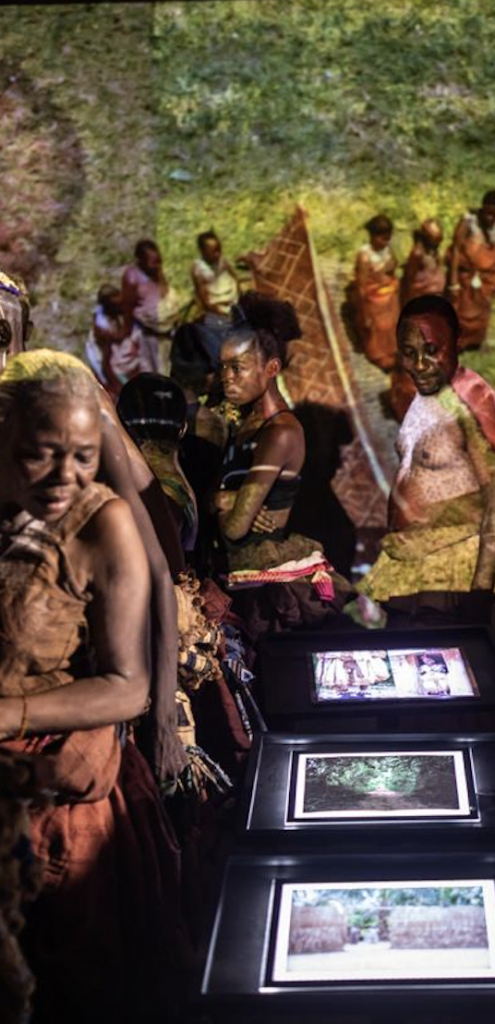
© Melisa Kayowa – Territoires Tissés
What happens when entire knowledge systems are absent from the datasets used to train contemporary AI models?
Several artists and researchers highlighted the limitations of current AI developments. Dominant technologies frequently overlook or distort African knowledge traditions, oral histories, local languages, and community practices. As a result, algorithms not only reinforce existing social inequalities, but also mask these biases behind a façade of objectivity and universality.
Multi-disciplinary artist and researcher Peace Olatunji (whose host institution is Gallery of Code in Abuja and his European partner is GLUON, in Brussels), responded to the above mentioned inequities with Untangler: Worlds Reimagined – an interactive audiovisual project that invites audiences to confront and question the biases embedded in contemporary AI systems.
Here, his work advocates for the creation of more accurate and ethical datasets developed through collaboration with Indigenous communities and institutions. The project raises a fundamental issue, explaining that much knowledge that exists outside conventional archives altogether and oral traditions, storytelling practices and embodied forms of cultural transmission are erased. This is due to the fact that they cannot be “translated” into the categories and structures favoured by machine learning systems.
In this case, language and its translation emerged as an important concern. Historically speaking language has always determined what and how knowledge becomes visible to technological systems. However, many African languages remain absent from major AI models, creating gaps that extend beyond representation into questions of cultural continuity and epistemological diversity. But rather than viewing these gaps as technical problems alone, participants framed them as opportunities to rethink the foundations of AI development itself.
…many African languages remain absent from major AI models, creating gaps that extend beyond representation into questions of cultural continuity and epistemological diversity.
That being said, what are the main frictions between AI cultural reconstruction and respecting Indigenous knowledge’s “authenticity”?
Khanya Mthethwa‘s project Adorned Memory: Reimagining Egyptian Indigenous Archives Through Jewellery, hosted by B’sarya for Arts in Alexandria and in partnership with CHRONIQUES in Marseille, explored whether AI could reconstruct Nubian identity from fragmented jewellery archives. The work ends up exposing the limitations of algorithmic reconstruction underlining that where AI encounters gaps and uncertainties, jewellery becomes an archive in its own right; carrying stories through material, form and embodied memory. Technologies may produce visual outcomes but not understanding.
Participants spoke passionately about the deep responsibilities that come with representing communities, histories, and identities. Many reminded us that even when people tell their own stories, it takes self-awareness to avoid reproducing harm. Being from a community or sharing a cultural background does not automatically make one’s account legitimate or “authentic”; these qualities are earned through trust, care, and ongoing dialogue. True engagement means working alongside knowledge holders, honoring community customs, and treating consent as an evolving conversation. In these conversations, it became clear that the future of AI is not just about technological breakthroughs but about the courage to act responsibly and the willingness to be accountable to those whose lives are affected. It is equally a question of responsibility.
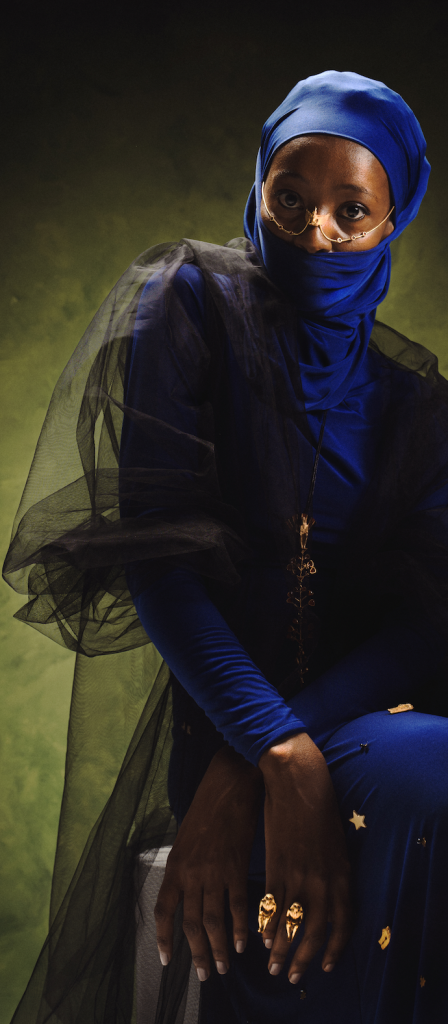
© Khanya Mthethwa – Adorned Memory
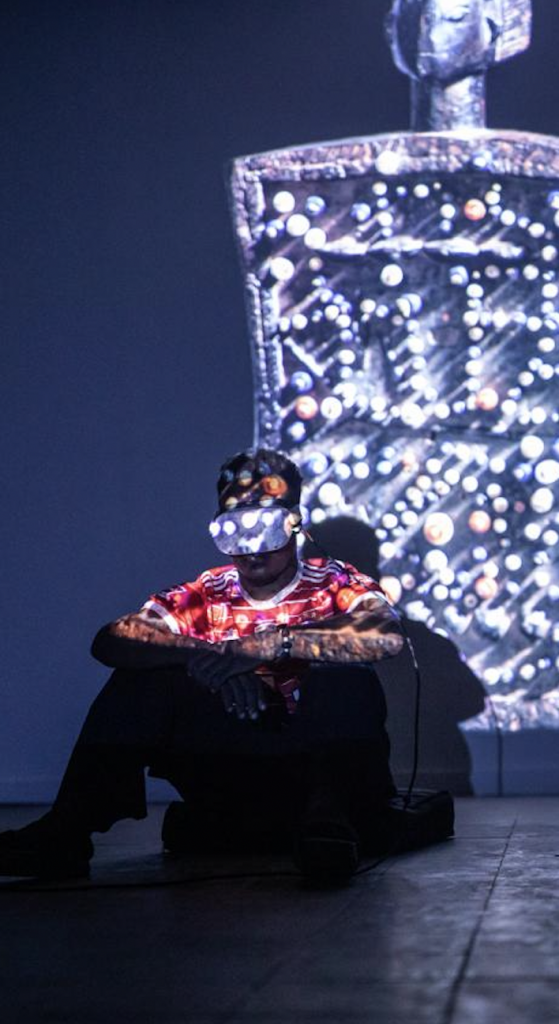
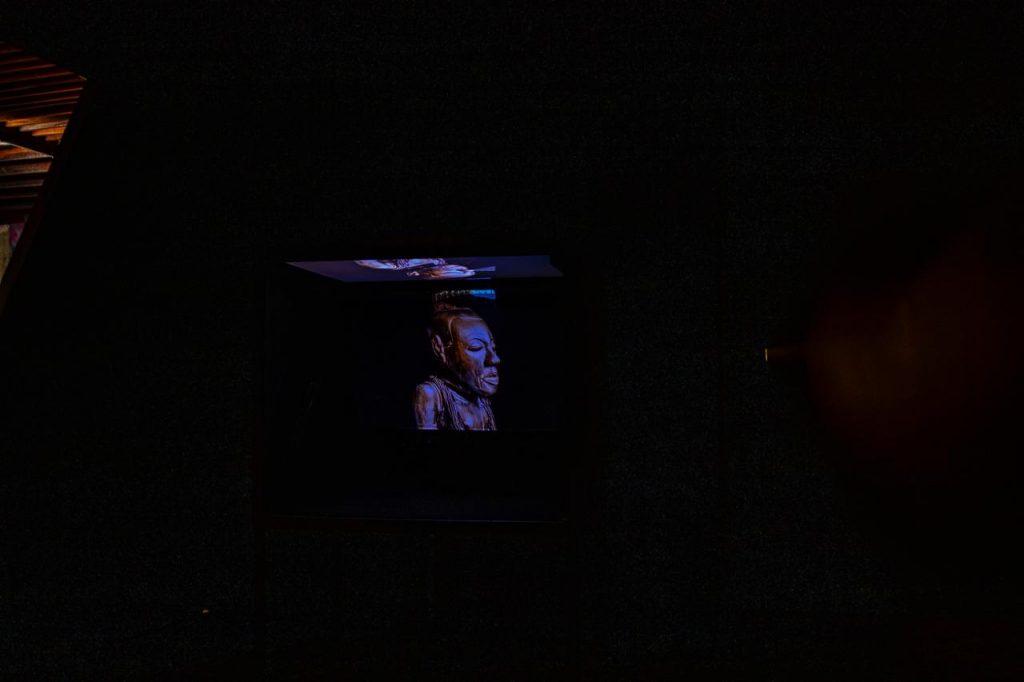
© Mahoutondji Kinmagbo – The Memory Performer
Can an AI trained on Indigenous knowledge genuinely embody an Indigenous epistemology?
Questions of context were explored further through the work The Memory Performer of Mahoutondji Kinmagbo, whose artistic practice engages with memory, restitution and Indigenous knowledge systems. Kinmagbo’s host institution is Krithika Art Projects in Kinshasa and is partnered with the Africa Museum in Tervuren. Drawing on Luba epistemologies, the artist researched how ancestral objects might be recontextualised through immersive VR experiences. Instead of reducing cultural artefacts to dead objects within museum collections, his work aims at restoring relationships between objects, communities and systems of knowledge.
This distinction is crucial: museification, as he calls it, often extracts objects from their original contexts, flattening complex cultural meanings into catalogues, classifications and displays. Recontextualisation, by contrast, attempts to reactivate those meanings. The artist’s work pivoted around the question: can an AI trained on Indigenous knowledge genuinely embody an Indigenous epistemology? The symposium did not provide a definitive answer. Instead, it encouraged participants to recognise that knowledge systems involve more than information; they include values, relationships, responsibilities and ways of being in the world.
In between panel discussions, the audience was able to experience a live audio-visual performance called Decoding Egwu: reclaiming indigenous intelligence through AI, dance and Igbo by Emmanuel Ndefo and Dan Xu. Through dance, movement and sound, these two collaborating artists have invited us to change our understandings of dance, embodiment and ancestral memory and knowledge by rooting their art in “egwu”, an Igbo concept that encompasses many at once. Behind this piece, we can find a deep desire for shedding light and reproducing communal practices of knowledge-making – practices that interrogate existing AI data sets and denounce the colonial acts of excluding Indigenous knowledge. This performance was carefully crafted with the support of the artists’ host institution Gallery of Code in Abuja, and their European partner GLUON in Brussels.
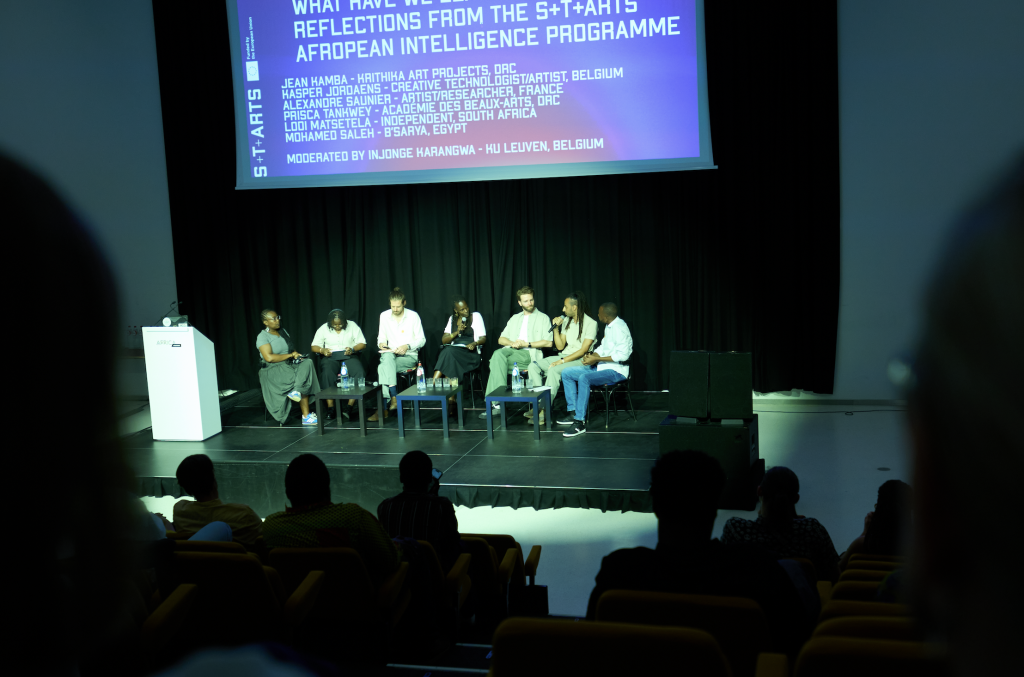
In the debate What Have We Learned? Critical Reflections From The S+T+ARTS AFROPEAN INTELLIGENCE Programme; Jean Kamba (CEO and Artistic Director of Krithika Artprojects), Kasper Jordaens (Artist – Researcher), Alexandre Saunier (Professor at LUCA School of Arts), Prisca Tankwey (Head of the Painting Department at the Academy of Fine Arts of Kinshasa), Lodi Matsetela (independent expert for the Creative Industries) and Mohamed Saleh (Co-founder of B’sarya for Arts) were invited to reflect and converse on the cross-sectoral collaborations between Africa and Europe on art and technology. The debate was moderated by Injonge Karangwa (artist and researcher). Here, they were prompted to critically assess what was learned throughout the residency programme. How does AI impact artists and their art? When shouldn’t these technologies be used? What is the main role of cultural institutions when it comes to technologically infused collaborative artistic and cultural projects? To answer these questions, guests often spoke on the need to increase accessibility and eliminate extractive logics. In this context, institutions were seen as bridging and facilitating actors that ought to ensure that the artists feel accompanied and have access to the knowledge and materials needed to construct their work. The projects are presented as co-creations with local communities where contribution, accessibility and reciprocity are priorities. The aim is to avoid imposing a subjectifying gaze onto people.
Prioritising these ethics means trying to create alliances between AI and social problems that local communities have vocalised wanting to find solutions to. These collaborative efforts allow the artists and institutions to participate in exchanges of information and knowledge and avoid their forceful extraction of Indigenous practices for external gains. Sharing technological knowledge across disciplines, institutions and geographies means meeting, feeling, bridging cultures, and inspiring each other to collaborate. The invited speakers have expressed not only experiencing a reciprocal transfer of knowledge but a desire to look for common meanings and goals.
Another round of artists were invited to present their work and partake in a panel discussion titled “Artists as catalysts of community-led archives”, moderated by Ayoko Mensah.
Here, Evans Akanyijuka presented the project LoRAs as an Archive, A living Archive which explored the development of transparent African AI models capable of incorporating local visual languages and geographically specific perspectives, with the help of his host institution The Market Photo Worship in Johannesburg, as well as his European partner CHRONIQUES in Marseille. Through what he described as “memory injections,” community-generated knowledge can intervene within AI systems, disrupting dominant narratives. This artist, too, has shown a deep commitment to consent and agency where community photographers contribute to datasets while retaining ownership and visibility, challenging extractive approaches to data collection.
Similarly, Tamer Elshabrawy‘s work Peripheral Mode used soundscapes, GPS technologies and AI classification systems to document routes and patterns. Not only is he using existing archives but he is using AI to create new archives. Here, what becomes archived is not merely a destination or object, but a process of movement through space. This particular artist and his project were hosted by B’sarya for Arts in Alexandria and were partnered with CHRONIQUES based in Marseille.
These projects point toward alternative models of technological development: models grounded in reciprocity, collaboration and situated knowledge rather than extraction and scale alone.
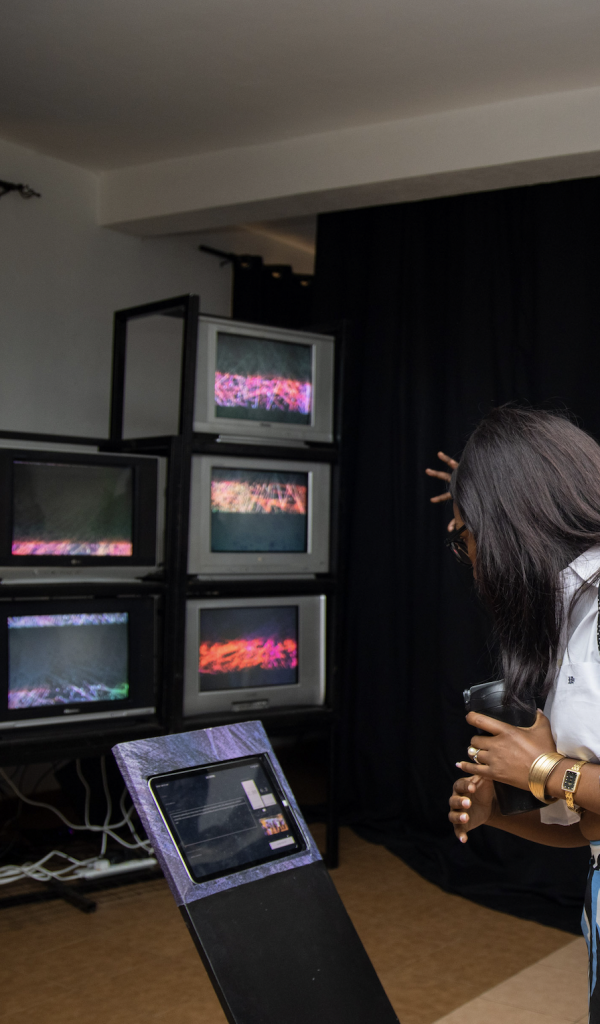
© Evans Akanyijuka –LoRAs as an Archive, A Living Archive
If archives preserve memory,
they also preserve possibility.
This idea became particularly visible in Pierre-Christophe Gam‘s project The Affogbolo’s Home. Drawing upon archival material, architecture, traditional arts and urban imagery, the project, hosted by Gallery of Code in Abuja and in partnership with GLUON in Brussels, creates a platform for imagining future African cities and societies. But instead of predicting the future, the work asks a different question: what future do we actually desire? This shift from prediction to imagination is fundamental since contemporary technological discourse often treats the future as something inevitable, as a destination determined by innovation, markets or algorithms but the artists invited at the symposium proposed an alternative perspective.
Imagination itself becomes a form of infrastructure. Before societies can build new worlds, they must first be able to envision them.
Chipo Mapondera’s Cry to the Water, which explored the intersections between climate resilience and Indigenous knowledge, was a powerful example of this idea. The project, hosted by the institution INTERFERENCE in Tunis and partnering with CHRONIQUES in Marseille, was developed together with women from Djerba, Tunisia, and links ancestral practices of water with current environmental issues. The work sheds light on a reality that is often overlooked: the climate crisis is also a crisis of cultural disconnection. As ecological systems change, traditional knowledge systems are also disappearing with them. AI is not framed as an autonomous authority, but as a community-led and culturally grounded companion, offering a different model of technological engagement, one that is grounded in care, continuity and collective responsibility.
How can institutions move beyond extractive models of partnership?
(…)
The symposium ended with a reflection on the opportunities and challenges for equitable Africa-Europe artistic, technological and cultural collaborations. The debate panel was composed of Khadouja Tamzini (Curator for INTERFERENCE Tunis), Oscar Ekponimo (Founding director for Gallery Of Code), Maciej Krzysztofowicz (Head of Design for Policy at JRC EU Policy Lab), Vanessa Hannesschläger (International Projects at Ars Electronica) and Robert Kieft (Deputy Director at EUNIC), and was moderated by Christophe de Jaeger (Director at GLUON). It is clear that all participants agreed that international collaborations are capable of expanding our imaginative and expressive abilities, bringing new perspectives and dimensions into local ecosystems. This includes European contexts, as it is believed that the collaborative effects translate into multidirectional education and engagement. The expansion of funding opportunities allows for art-driven innovation to flourish. It is important to fund art and culture beyond our borders, bring artists into conversation and reflect the multidisciplinarity that weaves our societies together. This goes to show that these opportunities not only offer guidance and support, but also open doors to important conversations.
Ultimately, in the discussions, conversations, debates and presentations conducted throughout the day these following questions rose: How can institutions move beyond extractive models of partnership? How can technological knowledge be shared across disciplines, geographies and communities without reproducing existing inequalities? How can collaboration become a process of mutual transformation rather than one-directional transfer? Mirroring the complexity of the topics, the answers were neither simple nor final but the day left participants with a compelling proposition. The future of technology does not depend solely on innovation. It depends on the kinds of relationships we cultivate around knowledge, memory and imagination.
S+T+ARTS Afropean Intelligence emerged not as a fixed framework but as an ongoing practice, one that recognises archives as living systems, values community knowledge as a source of innovation and insists that technological futures must be shaped by those most affected by them. And perhaps the most important lesson of the symposium was that preserving culture is not only about safeguarding the past. It is about creating the conditions for more culture, more knowledge and more futures to emerge.