Read:
Afropean Intelligence: A Situated Reflection on Knowledge, Memory, and Collective Futures.
The integration of artificial intelligence into the African landscape requires far more than a simple transfer of tools or codebases. It calls for a deeper interrogation of the socio-cultural frameworks and knowledge that underpins how we as Africans, creatives, technologists and beings relate to technology and more importantly, to each other. The real test of these systems will lie in their cultural competence: their ability to sense, interpret, and embody behaviours that make sense within our contexts, our rhythms, our ways of relating.
The S+T+ARTS Afropean Intelligence Bootcamp, convened at the Tshimologong Digital Innovation Precinct in November 2025, became exactly that kind of space. The S+T+ARTS Afropean Intelligence initiative seeks to question dominant technological narratives and investigate the local implications of artificial intelligence through public conversations, research-based formats and artistic residencies across Nigeria, Egypt, Tunisia, South Africa and the DRC. By uniting artists, scientists, and technologists, the project fosters cross-cultural dialogue and critical artistic innovation to examine the rapid rise of technologies like generative AI. My interpretation of the bootcamp is that it became a site for experimentation and exchange where various disciplines of art, research, and technology converged and informed one another. The bootcamp’s transversal themes such as representation & identity, urban futures & counter-mapping, taking back agency, and embodied & ancestral knowledge in AI resonate deeply with my own creative and academic practice.
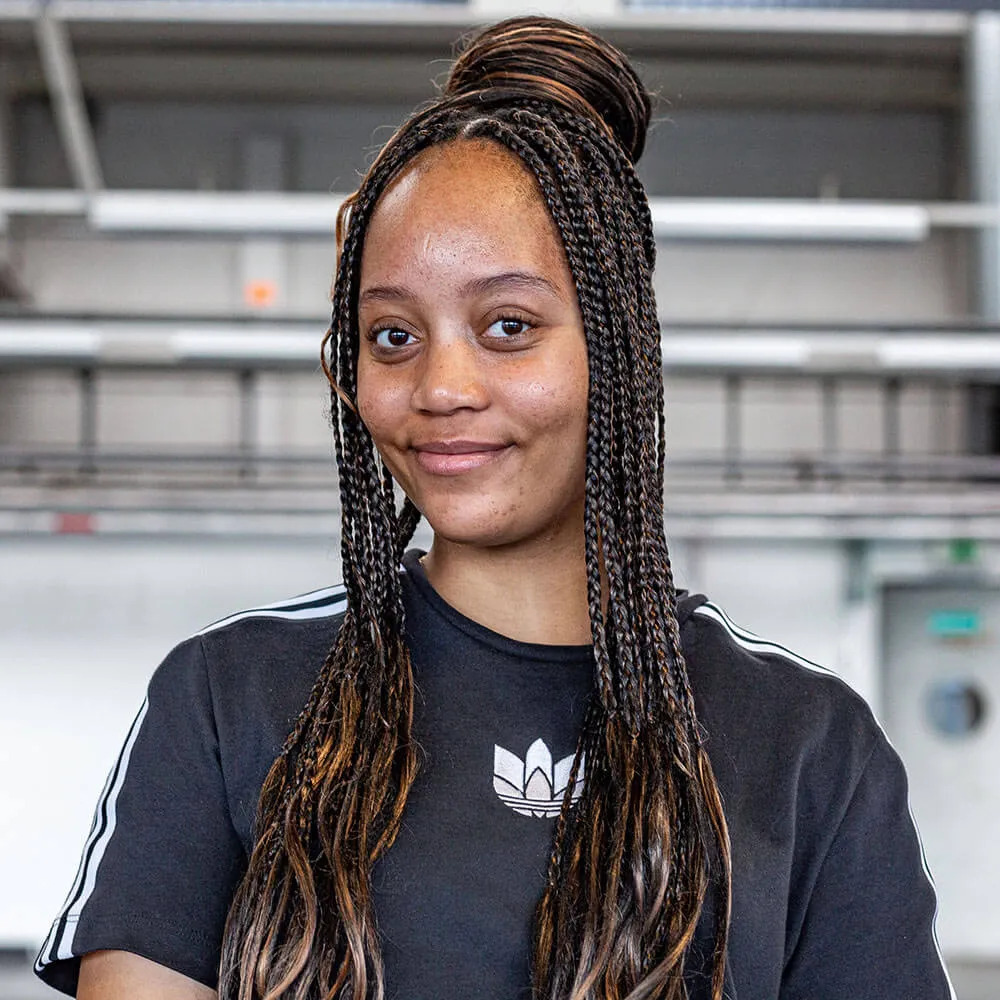
This article was written by Chelsi Goliath, as part of the S+T+ARTS Afropean Intelligence Bootcamp, in November 2025.

“a living archive…”
I am Chelsi Goliath, and I was invited to be part of this initiative. As a creative technologist and researcher working across AI, robotics, and generative disciplines, I approached my participation intentionally as both an observer and an interpreter. My goal was to document and understand the dialogues, moments, and conceptual conversations that emerged between the artists, researchers and cultural organisations as they explored AI through the lens of artistic projects developed within the S+T+ARTS Afropean Intelligence residencies, negotiating these critical intersections in their work and everyday lives. I interpreted this as a living archive to trace how participants navigate representation, embodiment, and digital agency across human, machine and artificial intelligence.
“Afrofuturism (…) as an ever-evolving topic”
In 2012, Kenyan filmmaker Wanuri Kahiu defined Afrofuturism as a tool to reject the “hopeless” narrative often projected onto Africa. She views it as “using science fiction, mythology, and fantasy to re-examine the African experience and imagine a future where Africa is a leader in technology and innovation.” She emphasizes that it allows Africans to “critique the present” by imagining a thriving future. Overall, I hope to honour Afrofuturism by engaging with it as an ever-evolving topic, shaped not only by aesthetic references but by lived experience, collective imagination and the unfolding realities of African technological futures. Written for us, by us.
Contextual Grounding: “Being in This Space”
My analysis focuses specifically on the Afrofutures Assembly, a collective working session organized by CHRONIQUES. Facilitated by Adwoa Ankoma (Director of Policy and Research at Electric South) and Ilaria Bondavalli (Head of EU projects – CHRONIQUES), the workshop was framed as a ‘Gathering to Reflect, Exchange and Envision Together’. Held on the final day of the Bootcamp, this session provided a critical space for participants to collectively deconstruct the themes of the week. We were invited to reflect on:
- What does it mean for you to be part of this Bootcamp, in this moment, in this space?
- How does being here connect to your sense of self as an African or Afropean artist, technologist, or researcher?
- What stories or ancestral references travel with you into this space?
These questions were not rhetorical. They invited us to bring whole selves into the room. As we moved around the circle, it became clear that no one arrived as a passive participant. We all carried memory, responsibility, lived experience, and inherited fragments of narrative. We often navigate between local identity and global narratives, especially when working with technologies that seldom account for African ways of knowing, believing or understanding.
When asked, “How does being here connect to your sense of self as an African / Afropean artist?” The dialogue revealed that for many of us, the practice of technology is a fundamental, political, and personal form of “taking back agency.” This “taking back” happens through some sort of navigational act. The selected artists part of the Afropean Intelligence initiative work within the realities of African contexts where access, infrastructure, and resources are often limited while confronting the fast-moving demands of global digital culture. By shaping their own narratives and cultivating collective knowledge, they actively resist digital marginalisation and assert their place within the technological future for the African diaspora in the global digital scene.
“Taking back agency”
Philosophical Reflection: “Reimagining Intelligence”
These grounding questions led naturally into the deeper philosophical themes explored during the Entropy Symposium. The Entropy Symposium was the concluding major event of the bootcamp structured as a series of four thematic sessions, each addressing specific critical challenges that are shaping the 10 Residencies Program of S+T+ARTS Afropean Intelligence within the field of artificial intelligence.
Challenges
Challenge 1 & 2 – Intercultural AI: Weaving Worlds through Art and Algorithms
Challenge 3 – Plural Computation
Challenge 4 – Psychogeography and the Influence of AI
Challenge 5 – Archives and Memory
Challenge 6 – ZaZi: An African Educational AI Model
Challenge 7 – Beyond Borders: AI, Climate, and Resource Justice in Africa
Challenge 8 – Digital Lukasa: An Intelligent Archival Tablet
Challenge 9 – Provenance and Social Memory
Challenge 10 – Futurism and Geolocation
We began with a focus on sustainability through a session titled “The Climate Cost of Intelligence,” which addressed Challenge #5. This was followed by a segment on biases titled “Bias by Design – Who Gets Seen, Served, or Silenced?” featuring speaker Steve James (University of the Witwatersrand) to explore Challenges #2 and #3. The discussion shifted to caution with Osmic Menoe (Back to the City Festival) presenting “AI as a Tool, AI as a Weapon,” covering Challenges #1, #4, and #7. The final thematic session led by Koketso Masuluke (Duende Meraki Cartel), focused on context under the title “Imagining African Interfaces” (Challenge #6). The symposium concluded with a word of thanks from Lodi Matsetela (Fakugesi) and closing remarks from Joy Mawela, the Head of the Digital Content Hub at Tshimologong. Each session pushed us to think critically about what intelligence even means in African contexts.
The recurring inquiries were:
- When you think of intelligence, what comes to mind (human, machine, spiritual, collective)?
- Can AI embody memory, emotion, or ancestry?
- How do scientific or data-driven systems sit alongside African ways of knowing?
What stood out most to me was how quickly the idea or concept of “intelligence” became fluid in the room. Participants spoke of it as something capable of holding memory, rhythm, symbolism, intuition, and relationality. The conversation shifted away from the technical act of “fixing bias” toward recognising that bias often emerges from a failure of translation. From this perspective, the biases we speak about in AI ethics become less about statistics and more about a structural incompatibility between binary data and fluid cultural heritage, causing systems to fail to recognise the full spectrum of what can count as knowledge.
Reimagining intelligence becomes a creative and cultural project: one that demands new interfaces, new metaphors, and new ways of holding knowledge that honour African modes of understanding.
“Holding knowledge that honour African modes of understanding”
On Collaboration & Community:
“Learning from Each Other”
The question of collaboration was central: “Have any conversations here shifted the way you think about your own practice?” and across the week, the answer was almost always yes.
What unfolded in the Bootcamp was not collaboration in the institutional sense, but something more organic, knowledge moving sideways, diagonally, unexpectedly. These exchanges suggested that the Bootcamp was indeed a ritual. It was a space where a distributed network of thinkers learned to produce a knowledge that is far greater without hierarchy. Ideas didn’t belong to individuals, they passed through the room and kept evolving as different hands and minds shaped them. The Bootcamp revealed that collective intelligence is not a metaphor but a lived practice. It is a distributed system of thinkers learning from one another, producing knowledge that is richer and more layered than any single discipline could generate.
It became clear that African innovation thrives because of Ubuntu. Ubuntu is an African philosophy emphasising interconnectedness, compassion, and communal harmony. “I am because we are”. It holds that a person’s identity is shaped by their relationships with others and that collective well-being is paramount, promoting values like empathy, respect, and shared responsibility.
Collaboration here felt less like a project and more like a form of witnessing: recognising yourself in someone else’s process, allowing their approach to expand your own, and understanding that this kind of cross-pollination is itself a methodology.
Conclusion:
“Imagining Otherwise”
As the week drew to a close, the energy shifted from critique to creation. We moved beyond asking what is wrong with AI, to asking what it could become.
- If you could imagine an African AI, what would it look, feel, or sound like?
- What does a decolonised digital future mean to you personally?
- How can technologies remember where they come from?
People imagined an African AI that feels rhythmic, embodied, context-aware; an intelligence that holds memory instead of erasing it; a system capable of listening as much as computing. A decolonised digital future, for many of us, is one where machines amplify the predecessor’s whisper rather than overwrite it.
+
My biggest takeaway from the Bootcamp is that imagining African AI and understanding Afrofuturism is not a technological exercise, it is largely a very cultural and social one. It requires grounding in community, ancestry, embodiment, and the multiplicity of African lived experiences. African technological innovation is already here. It simply needs spaces much like this one, where our stories, methodologies, and ways of knowing can shape the systems we are building.Participating in the S+T+ARTS Afropean Intelligence Bootcamp offered all participants a profound moment of reflection. Together, we began forming a cross-disciplinary vocabulary that connects intelligence with the somatic, performance, and lived experience. The challenge now is to keep these exchanges alive, to build systems that remember their origins, honour their contexts, and reflect the people and knowledge traditions that shaped them.
Explore:
Visual Concept: The Afropean Intelligence Wheel
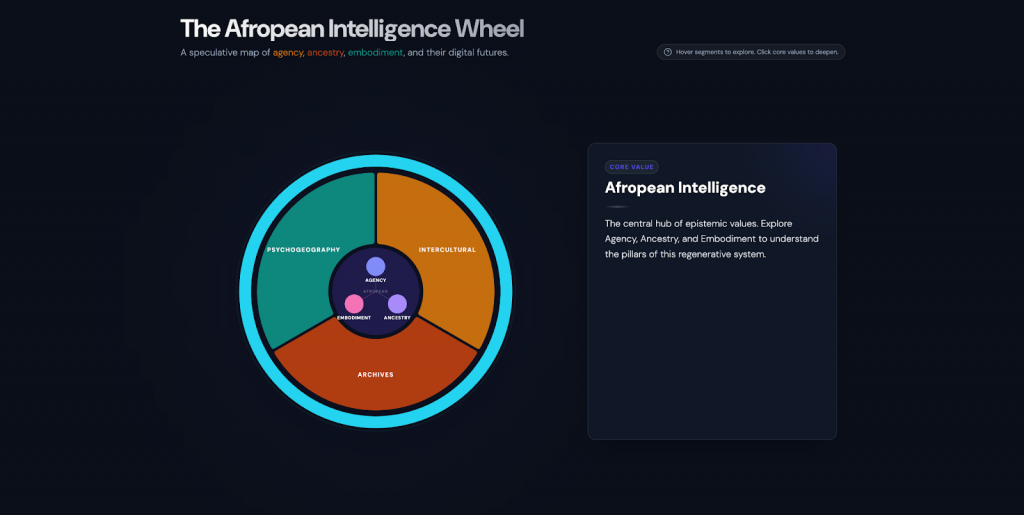
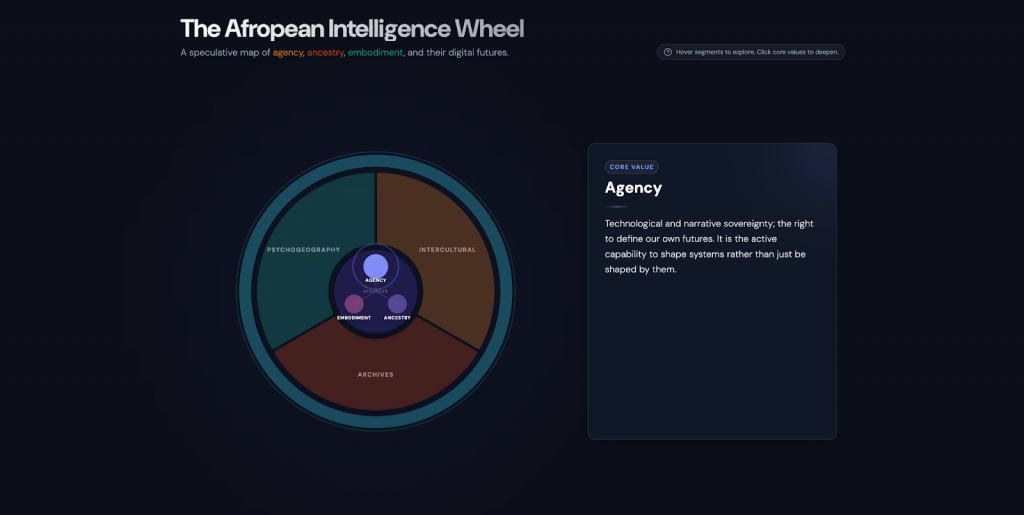
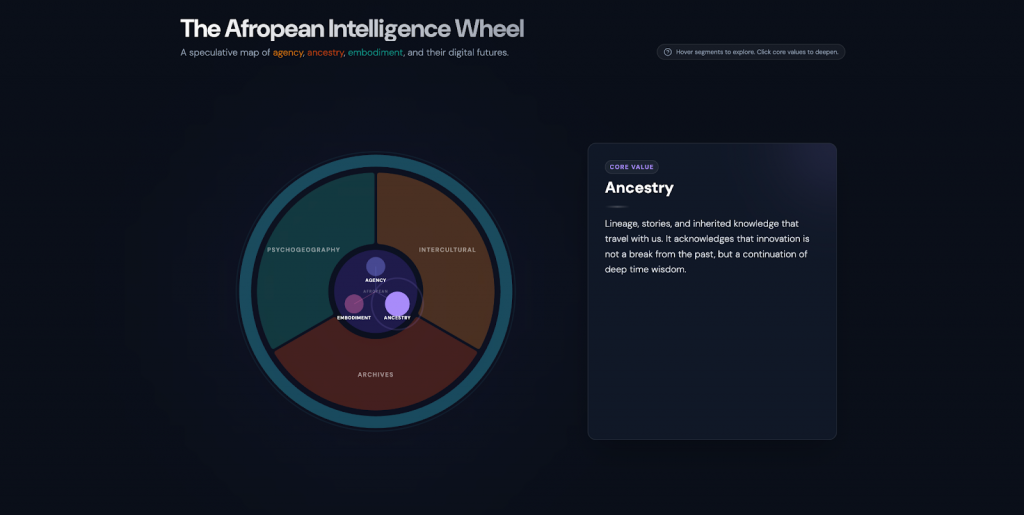
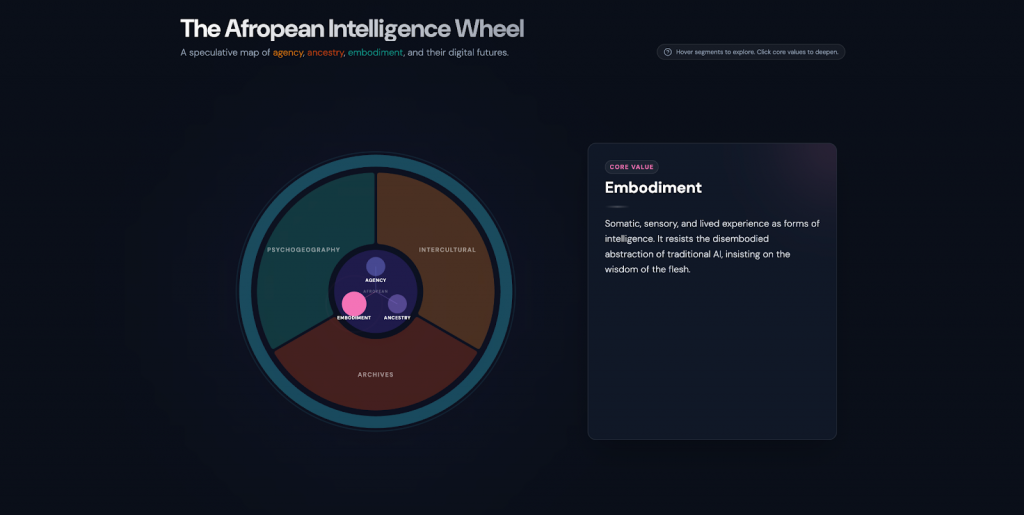
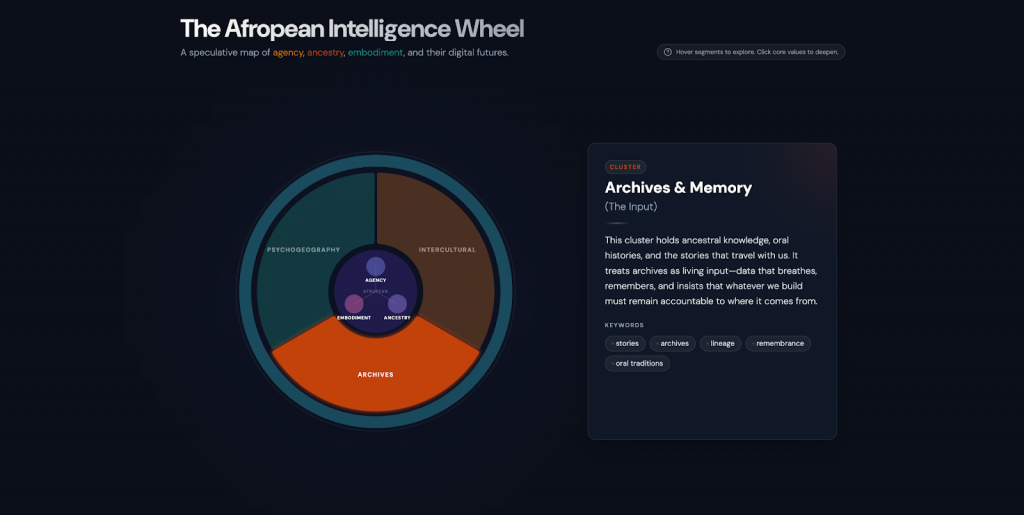
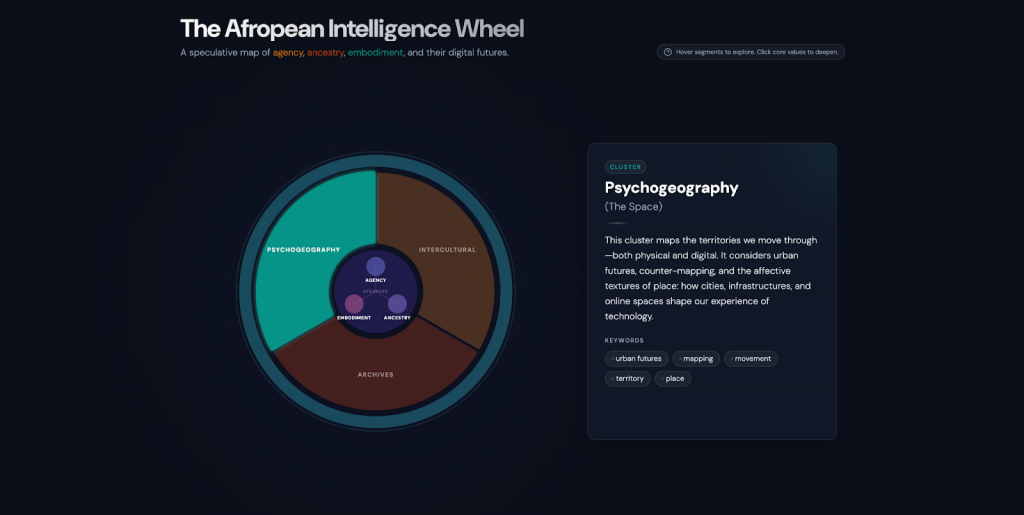
The Afropean Intelligence Wheel is a speculative visualisation designed to illustrate the cross-pollinations that emerged throughout the Bootcamp. Rather than presenting the themes in a linear or hierarchical manner, the wheel frames Afropean Intelligence as a cyclical, regenerative ecosystem, where ideas, practices, and ways of knowing continually feed into one another. The structure reflects how knowledge actually moved during the week: in loops, through exchanges, across disciplines, and between people. The circular form borrows from the “education wheel” model and mirrors knowledge systems that prioritise continuity, return, and relationality. It avoids the hierarchy of top-down diagrams, instead situating intelligence as something that lives at the center and radiates outwards shaped by community, memory, place, and human–machine negotiation.
Core Epistemic Center
At the heart of the wheel is “Afropean Intelligence: Core Epistemic Values”, composed of Agency, Ancestry, and Embodiment. These values act as the foundation of the entire framework. They express the idea that technological futures in African contexts must be grounded in self-determination, lineage, lived experience and relational knowledge, not only computation or imported design logics.
The Three
Interlocking Clusters
Around this core are three interconnected clusters, each one representing a major thematic current that flowed through the Bootcamp and related to the topics explored by the artists in the residencies programme:
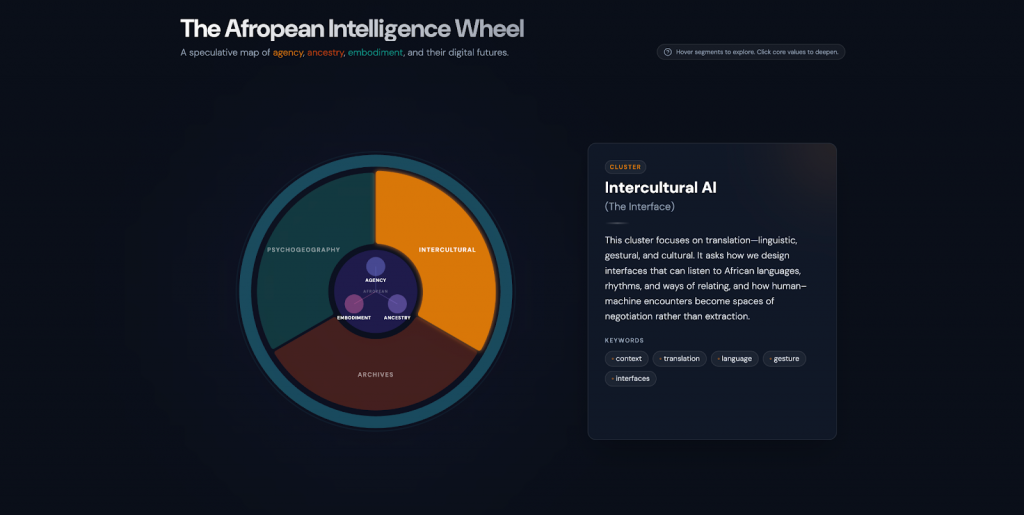
1. Intercultural AI (The Interface)
This cluster focuses on translation, linguistic, gestural, and cultural. It reflects conversations about designing interfaces that can listen to and communicate through African languages, rhythms, and ways of relating. It highlights the Bootcamp’s emphasis on context, meaning-making, and the negotiation between humans and technologies.
2. Archives & Memory (The Input)
This cluster anchors the wheel through ancestral knowledge, oral histories, and “stories that travel with us.” It conceptualises archives as living data sources, insisting that technological futures must remain connected to the lineages and communities they emerge from.
3. Psychogeography (The Space)
This cluster captures how physical and digital cities, infrastructures, and online spaces shape our experience of technology. It reflects the Bootcamp’s discussions on counter-mapping, urban futures, and the emotional textures of place.
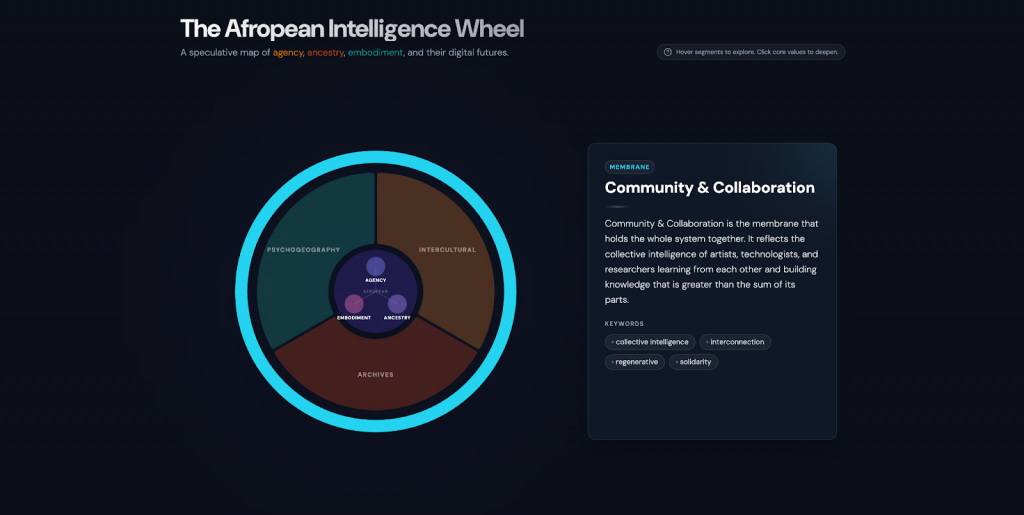
Community & Collaboration as the Outer Membrane
Surrounding the entire wheel is a thin but essential ring labelled “Community & Collaboration.” This membrane represents the collective intelligence that defined the Bootcamp: ideas circulating between artists, technologists, researchers and cultural organisations; learning happening laterally rather than vertically; and knowledge being formed through conversation, witnessing, and shared experimentation. The membrane holds the entire system together, reminding us that no cluster stands in isolation.
How the Wheel Works
The interactive web-based version of the Afropean Intelligence Wheel extends this conceptual structure into a dynamic experience:
- Hovering or tapping on each cluster reveals a short explanation and key terms, allowing the viewer to explore the concepts at their own pace.
- Clicking the core values (Agency, Ancestry, Embodiment) highlights their influence on the surrounding clusters, visualising how these values radiate outward to shape interaction, memory, and space.
- The outer membrane gently responds to interaction, reaffirming the idea that collaboration is what holds the system together.
- Optional connections appear between clusters, showing how ideas intersect for example, how Intercultural AI relates to Psychogeography, or how Memory informs Interface design.
The Afropean Intelligence Wheel is not meant to “explain” Afropean Intelligence as a fixed category. Instead, it serves as a speculative map: a visual and conceptual tool that holds together the themes, conversations, values, and tensions that shaped the Bootcamp. It attempts to honour the nonlinear, relational, and deeply contextual ways that African creators think about intelligence, memory, and the technological futures we are collectively building.