Helping Experiments Connect: The Story of HECLab ○ S+T+ARTS Hungry EcoCities
Every great story starts with a good idea. Meet HECLab: The digital heartbeat of art-driven innovation in the food sector, bridging technology and a healthier future through an online platform that promotes the adoption of digital technologies.
In this article:
- Bridging the Innovation Gap: What is HECLab?
- Why was it created?
- How was it used in the Hungry EcoCities project?
- A legacy of the HungryEcoCities project
- How it works: AI-Driven matchmaking
- Current Status and Future Outlook
- Looking Ahead: 2027 and Beyond
Bridging the Innovation Gap: What is HECLab?
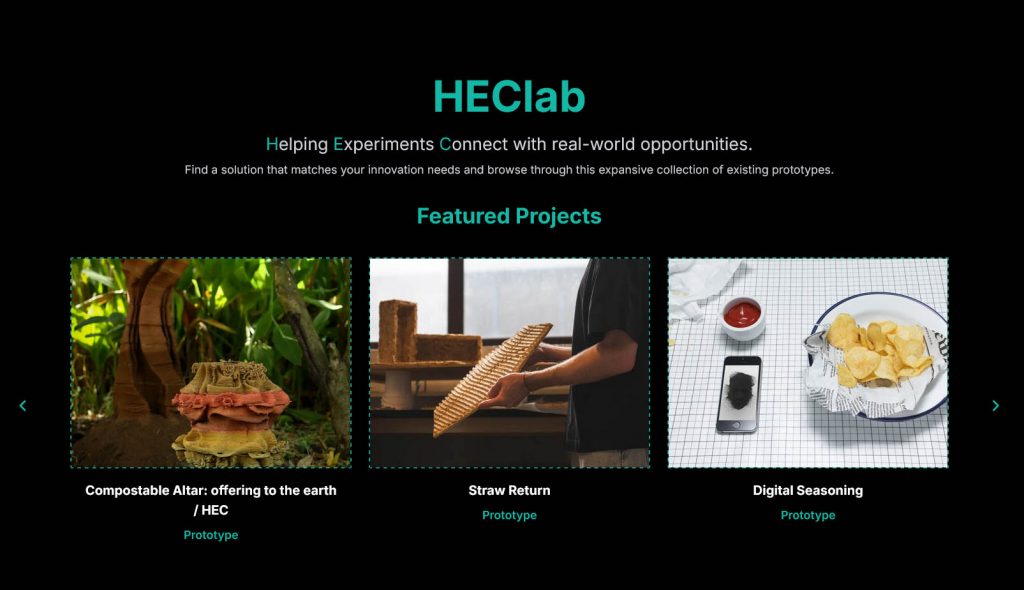
HECLab acts as a virtual laboratory specifically built to empower the valorisation of art-driven prototypes. While matchmaking platforms often emphasise the early stages of ideation or the final stages of commercialisation and scaling up, it is the phase in between, going from early prototype to validated innovation, which is often forgotten. HECLab focuses on this critical gap – specifically Technology Readiness Levels (TRL) 4 to 6 – by facilitating the demonstration, validation, and real-world application of innovative solutions. Originally developed as an internal matchmaking tool for the Horizon Europe Hungry EcoCities project, HECLab has evolved into a platform for ongoing opportunity matching: It helps creators connect with opportunities to test, improve and validate their innovations within the food sector. The platform creates a bridge between proof-of-concept prototypes and operational environments. While its name stems from the project that birthed it, the team has re-interpreted the acronym to reflect its core mission: “Helping Experiments Connect” with real-world opportunities.
Why was it created?
The platform was born from a recognition that art-driven and creative innovations often lack a pathway to practical application. During the early stages of the Hungry EcoCities project, it became evident that artists and creative technologists often struggled to monitor new calls for applications or find industry partners relevant to their prototypes. Consequently, the HECLab was conceptualised not just as a repository for project results, but as a dynamic tool to ensure these innovations do not simply disappear after a project ends. Its goal is to provide a specialised matchmaking environment that connects proof-of-concept prototypes with the funding, collaboration, and testing environments necessary to validate, test or even scale them.
How was it used in the Hungry EcoCities project?
Within the Hungry EcoCities project, HECLab served as the digital backbone for forming the “Path to Progress Experiments” (PPEs) – collaborations between industrial food SMEs and digital artists. The platform replaced traditional, intuition-based matchmaking with a data-driven, elaborated process designed to bridge the gap between artistic prototypes and industrial needs.
The matchmaking process on HECLab was built around two core components:
- Opportunity Cards (SMEs)
After defining their specific challenges (ranging from AI integration in seed breeding to climate control in vertical farming), the 10 participating SMEs created “Opportunity Cards” on the platform detailing their needs. - Prototype Cards (Artists)
The 48 participating artists were asked to upload “Prototype Cards” – showcasing previous works that had already reached a Technology Readiness Level (TRL) of 4 or higher. Over 80 prototypes were digitised into the system.
HECLab’s algorithm analysed these inputs to generate personalised dashboards for the artists. Instead of browsing aimlessly, artists received specific recommendations on which SMEs were the best fit for their skills and existing technologies. The system was highly effective, producing match recommendations for 47 out of the 48 participating artists.
The platform’s digital logic aligned remarkably well with real-world chemistry. Ultimately, 8 out of the 10 final selected artist-SME pairs were matches recommended by the HECLab system. This high success rate validated HECLab not just as a repository, but as a sophisticated tool capable of identifying meaningful cross-disciplinary connections that might otherwise be missed.
A legacy of the Hungry EcoCities project
HECLab is a direct output of the Hungry EcoCities (HEC) project, a Horizon Europe Research and Innovation Action part of the S+T+ARTS programme. From the project’s inception, the intention was to build a platform that would outlive the project itself.
The HEC project served as the ideal testing ground for the platform. The lab was developed and tested using HEC’s own “Path to Progress Experiments” (PPEs) and “Humanizing Technology Experiments” (HTEs). In this sense being a technology innovation in itself. By processing the learnings from matching 10 SMEs with over 80 artists during the project, the team successfully evolved the beta version into a public source of inspiration – for innovators interested in the intersection of art, science, and policy, as well as for those seeking alternative perspectives and approaches to responsible and open innovation.
How it works: AI-Driven matchmaking
The core function of HECLab is sophisticated matchmaking. It allows users to register “prototype cards” (innovations looking for development) and “opportunity cards” (calls for solutions, funding, or testing sites). To facilitate these connections, HEClab 2.0 employs advanced features:
● AI Scouting
An automated bot regularly scouts external sources, such as the European Commission’s funding portal, to identify food-related opportunities and add them to the platform.
● Smart Matching
The platform utilises Large Language Models (LLMs) and semantic text scouting to analyse the compatibility between prototypes and opportunities, going beyond simple keyword matching to understand context.
● Dashboards
Users have access to personalised dashboards where prototype owners receive notifications about potential matches and opportunity owners can view prototypes that fit their specific needs.
Current Status and Future Outlook
As the Hungry EcoCities project concludes in February 2026, HECLab is transitioning from a project-based experiment to a sustainable, standalone platform. To ensure its longevity, the consortium, led by In4Art and Brno University of Technology, has committed to maintaining operations throughout 2026, executing a promising “Three-Pillar Strategy” designed to secure the platform’s future for 2027 and beyond.
1 ● Open and Free for Artists
True to its roots, HECLab will remain entirely free for artists and creatives. The platform believes that the best innovations should be accessible, regardless of a creator’s ability to pay. Artists “pay” simply by contributing their prototypes to the database, which serves as a source of inspiration for the wider community.
2 ● Private Licensing for Business
For the first time, HECLab is offering a private, license-based version of the platform for commercial use. This version acts as an internal R&D tool for businesses to organize their own “dormant” prototypes – internal proofs-of-concept that often go unused – and match them with company opportunities using HECLab’s AI agents. The goal is to secure the first launching customers for this private tier in 2026.
3 ● A Tool for International Consortia
HECLab is actively being integrated into new European project proposals. It serves as a ready-made infrastructure for managing “cascade funding” calls and consortium matchmaking, eliminating the need for future projects to build these tools from scratch. It has already been incorporated into five new project proposals.
Looking Ahead: 2027 and Beyond
The long-term ambition is to establish HECLab as the premier European platform for art-driven innovation realisation. While the platform maintains a strong heritage in the agri-food sector, the roadmap for 2027 includes expanding into other sectors where art-science collaboration can drive sustainability. By securing commercial licenses and partnering with major networks like S+T+ARTS on the one hand and on the other hand with the EUFarmbook and Sustainable Food Innovation Platform, both spaces created to support everyone working toward healthier, fairer and more sustainable food systems across Europe, HECLab aims to scale up, proving that a digital ecosystem for creative experimentation can be both impactful and financially self-sustaining.

The HungryEcoCities project has received funding from the European Union’s Horizon Europe research and innovation programme under grant agreement 101069990.