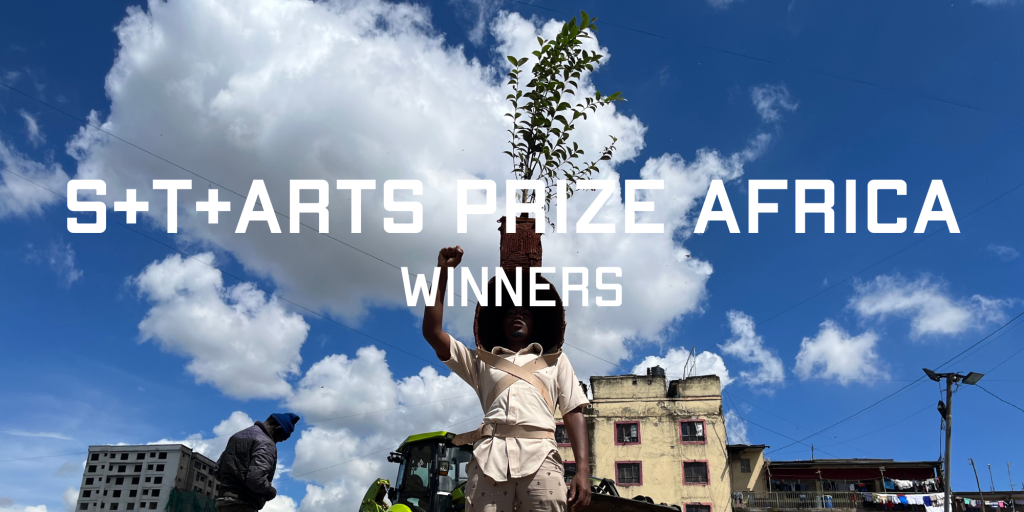
Grand prize of the European Commission honoring Innovation in Technology, Industry and Society stimulated by the Arts
The STARTS yearly competition is back to award the most pioneering collaborations and results in the field of creativity and innovation at the crossings of science and technology with the arts. Since 2016, more than 350 projects out of 18.900 submissions from 124 different countries have been honored and a total of €400,000 in prize money has been distributed in the STARTS Prize competition.
Win 20.000 Euros and present your work at the Ars Electronica Festival 2026
Two Grand Prizes, each with €20,000 prize money, are offered to honor innovative projects at the intersection of science, technology and the arts. The emphasis of both prizes lies on the creative appropriation and employment of technologies as well as the search for unique constellations of collaboration from the STARTS fields.
- Grand Prize – Innovative Collaboration honors innovative collaboration between industry or technology and the artistic (and creative) sectors that open up new avenues for innovation.
- Grand Prize – Artistic Exploration honors artistic research and works whose adoption by the arts has great potential to influence or change the use, application, or perception of technology.
Winners will be prominently featured at the Ars Electronica Festival and other events of the consortium partners INOVA+, French Tech Grand Provence, Media Solutions Center Baden-Württemberg, HLRS High Performance Computer Center Stuttgart, Salzburg Festival, Sonar, T6Ecosystems, and Kustodie at TUD Dresden University of Technology.
What can be submitted?
- Groundbreaking collaborations and projects driven by both technology and the arts. Purely artistic or technologically driven projects are not the focus of this competition.
- All forms of artistic works and practices with a strong link to innovation in technology, business and/or society; furthermore, STARTS is not restricted to a particular genre such as media art and digital art.
- All types of technological and scientific research and development that has been inspired by art or involves artists as catalysts of novel thinking.
- The jury is looking forward to receiving submissions from a broad variety of fields and disciplines. Among others, projects from the areas of new media applications, human computer interaction, machine learning, biotechnology, art & science, green technologies, material research, smart cities and citizen empowerment, robotics, quantum technology and many more are very welcome to apply.
- For inspiration, have a look at our broad range of winners, honorary mentions and nominations of the past years.
Who can enter?
- Artists/creative professionals or the researchers/companies involved from throughout the world; STARTS is not limited to citizens of EU-member states.
According to which criteria are the entries judged?
- Quality of the artistic research and its potential influence on technology.
- Quality and success of the collaboration between art and technology.
- Quality and intensity of the connection to innovation, education, social inclusion or sustainability.
- Quality and implementation of the European Dimension of the submitted project.
- General criteria such as aesthetics, originality, convincing concept, innovation and the technique and quality of the presentation.
What is the timeline?
- The submission process for the STARTS Prize 2026 started on January 7, 2026 and will end on March 9, 2026.
- The jury convenes from April 16, 2026 to April 19, 2026. All STARTS Prize 2026 winners will be notified by mid-May 2026 at the latest.
Where and when will the winning projects be presented?
- At the Ars Electronica Festival on 9-13 September 2026 in Linz, Austria, and at various exhibitions and events of the consortium partners worldwide.
Subscribe to the STARTS Newsletter to keep updated


The project is funded by the European Union under the Grant Agreement No 101135691. Views and opinions expressed are however those of the author(s) only and do not necessarily reflect those of the European Union. The European Union cannot be held responsible for them.