S+T+ARTS at Ars Electronica Festival 2026
9–13 September 2026 · Linz, Austria.
Art, science and technology meet in Linz for a special edition of the Ars Electronica Festival.
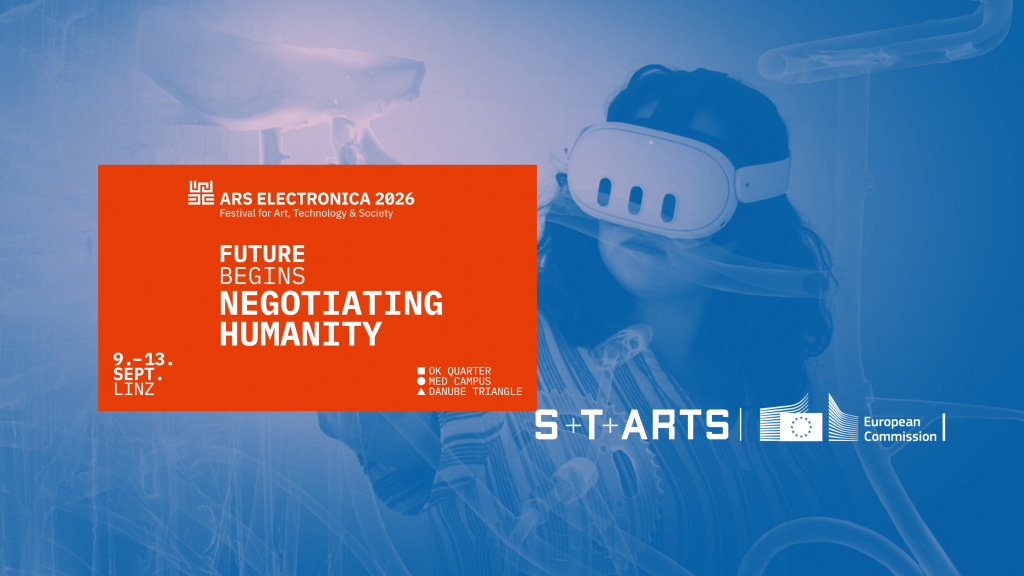
Cover © Feeling Virtual, An Archive of Touch by Iz Paehr. Image: Jasper Meiners.
The 2026 Ars Electronica Festival marks a special moment for the S+T+ARTS community.
After a decade of European collaborations connecting artists, scientists, technologists, cultural organisations and institutions, S+T+ARTS comes together one last time at Ars Electronica to share projects, ideas and experiences — and to look towards what comes next.
From exhibitions and conference sessions to Town Hall meetings and networking opportunities, discover the S+T+ARTS programme at Ars Electronica 2026.
A decade of collaboration
— and a conversation about what comes next
For almost a decade, S+T+ARTS has supported artists working across disciplines, creating spaces where artistic practice can challenge technological development, open new research directions and imagine alternative futures. As the current European programme approaches its final chapter, Ars Electronica provides an opportunity to gather the community, reflect on what has been built together, and explore how these collaborations, methodologies and ways of working can continue to evolve.
This is not simply a look back. It is a moment to connect, exchange and imagine what comes next.
___ + Exhibitions: S+T+ARTS within Negotiating Humanity
This year’s Ars Electronica theme exhibition, Negotiating Humanity, approaches art as a space for questioning perceived certainties and negotiating the realities we share. Across three interconnected exhibitions, it explores how realities are produced — through systems of belief, cultural narratives, technological infrastructures, embodied experience and our changing understanding of the human. The exhibition unfolds across three distinct settings: Negotiating Humanity at Lentos Kunstmuseum, Negotiating Beyond Humanity at the Ursulinenhof Attics, and Negotiating the Real, a Festival Walk connecting eight locations across the OK QUARTER.
Works from the S+T+ARTS ecosystem are embedded within this broader curatorial framework, entering into dialogue with questions around technology, perception, power, coexistence and the conditions through which realities become visible and meaningful.
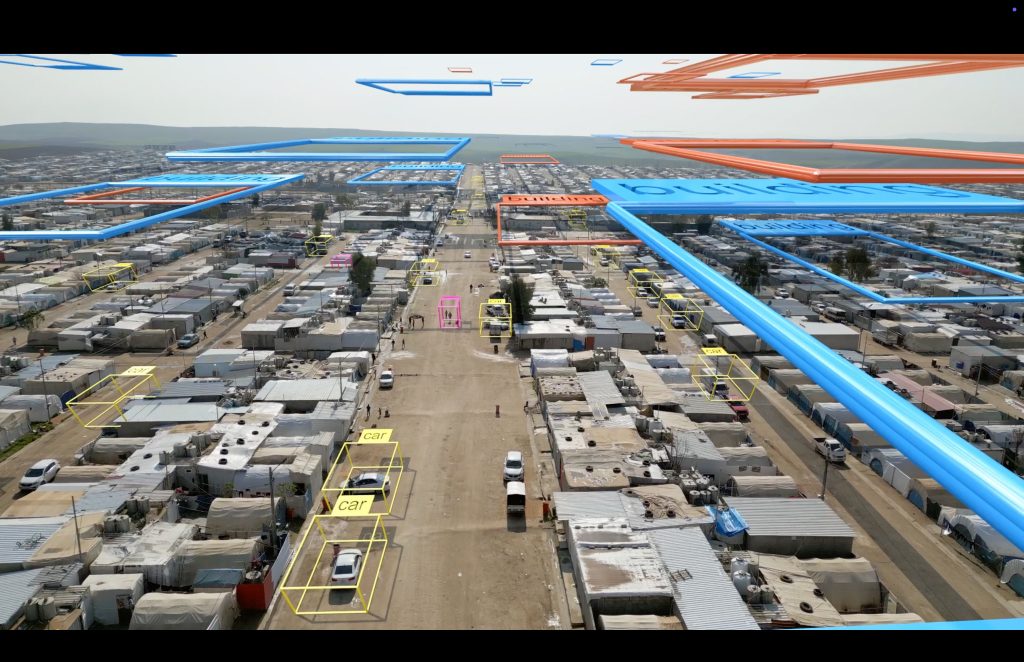

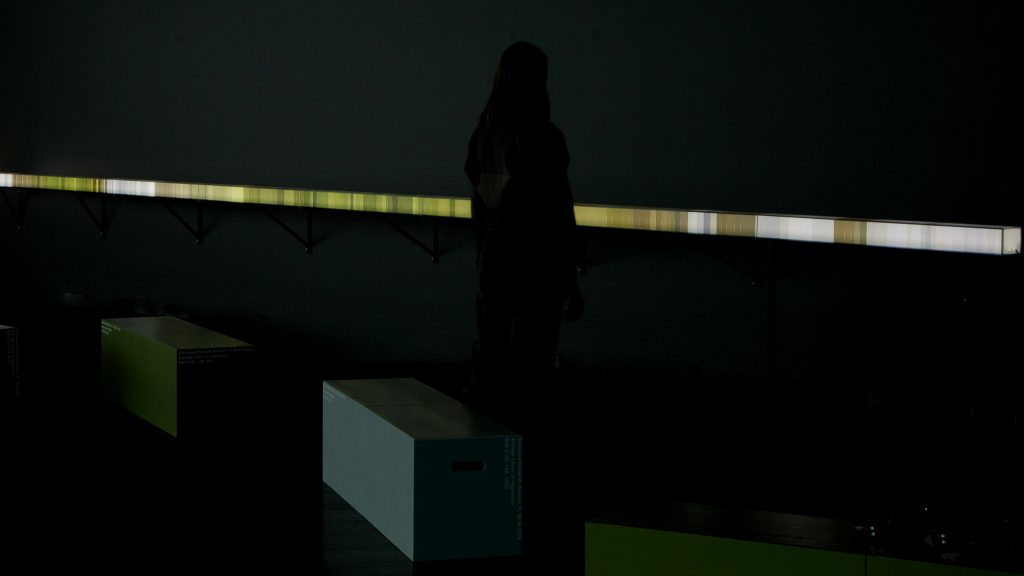
Mechanical Kurds Hito Steyerl (DE)
(S+T+ARTS Prize 2026 – Artistic Exploration)
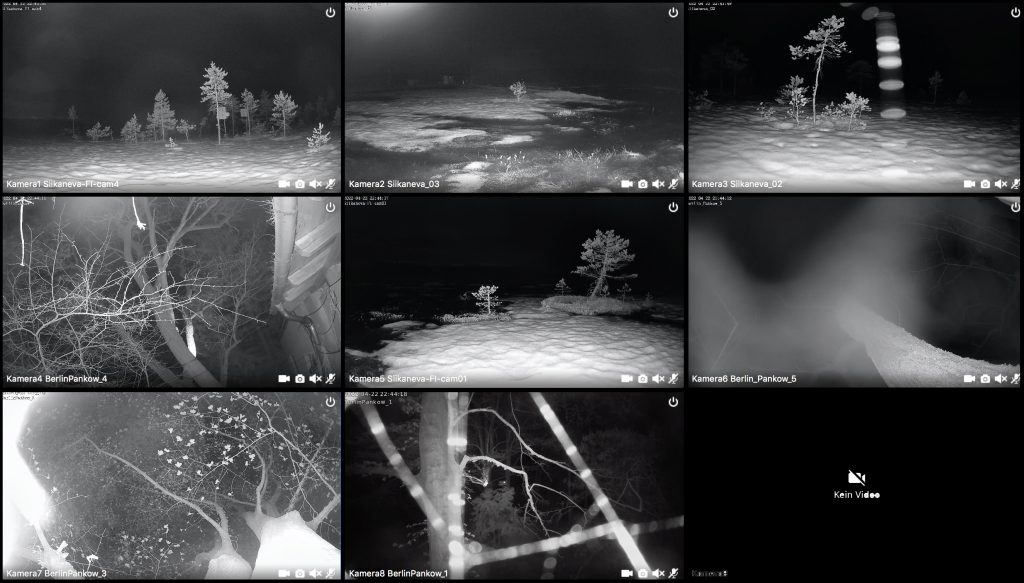
Office for Tree Migration (OTM) Agnes Meyer-Brandis (DE)
(S+T+ARTS Prize 2026 – Innovative Collaboration)
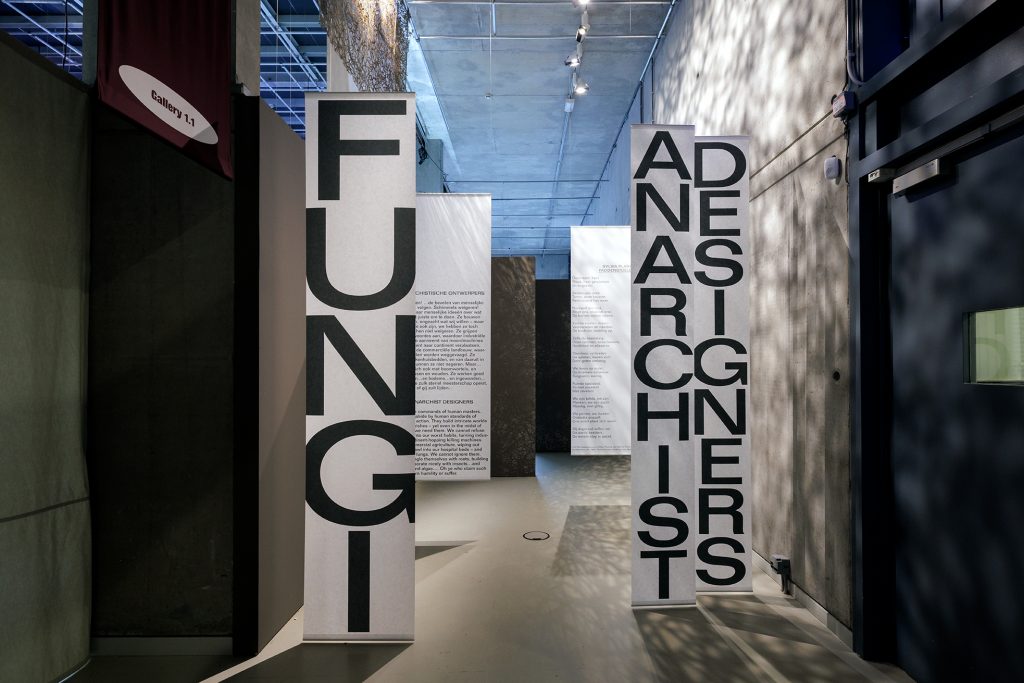
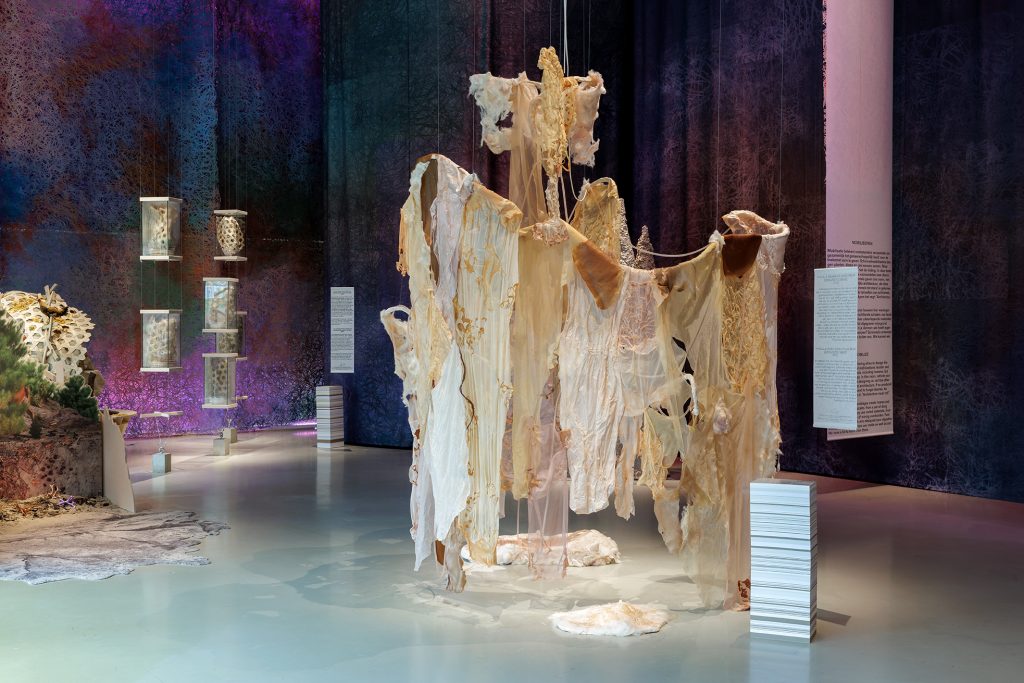
FUNGI: Anarchist Designers Anna Lowenhaupt Tsing (US), Feifei Zhou (CN), Nieuwe Instituut (NL) (S+T+ARTS Prize 2026 – Nomination)
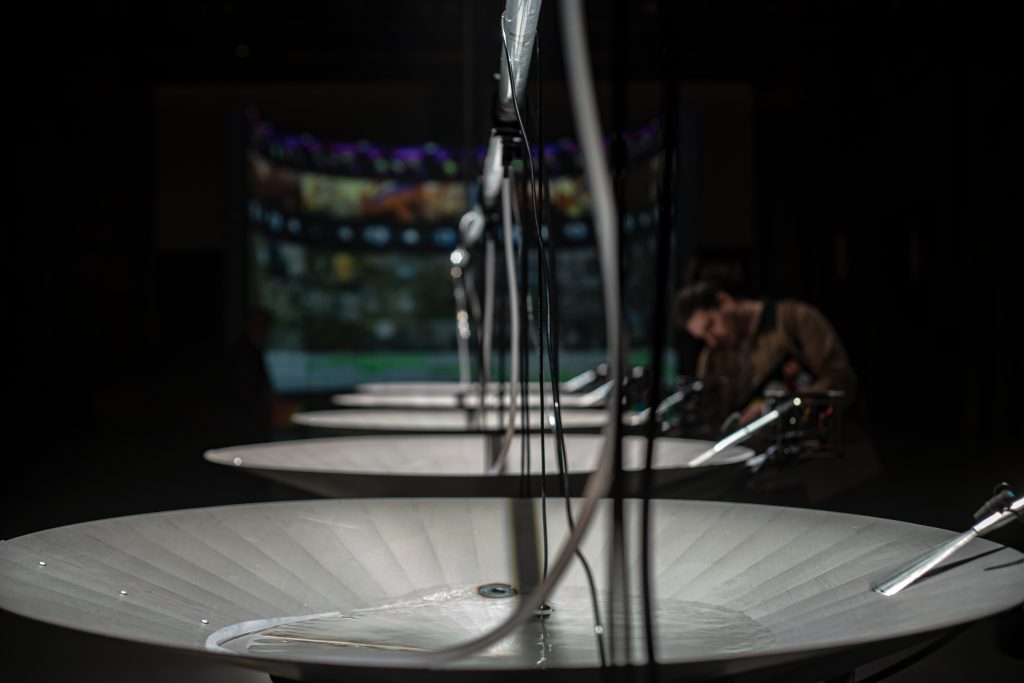

Drumming for Love Erze Dinarama (XK) (S+T+ARTS Prize 2026 – Honorary Mention)
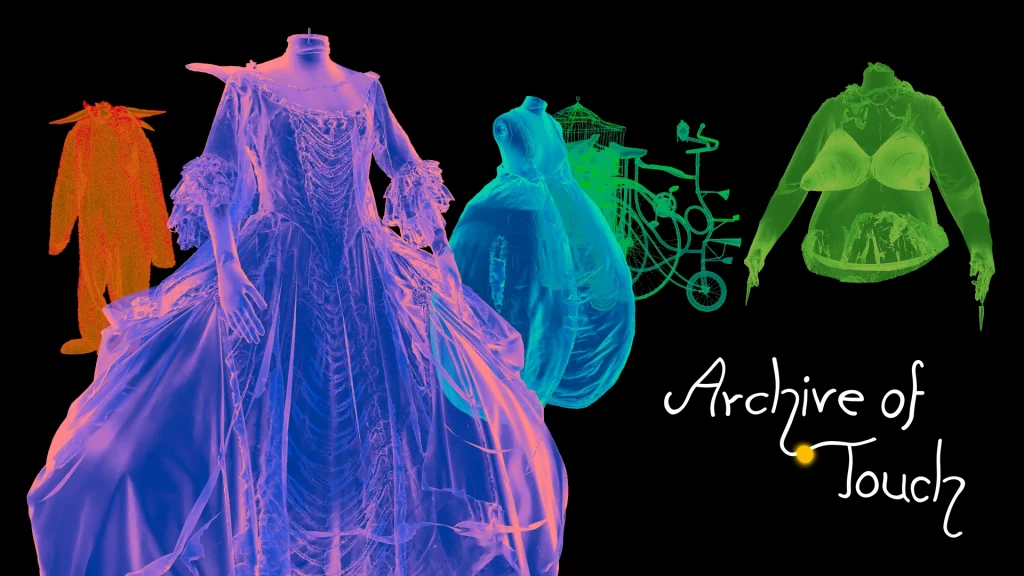
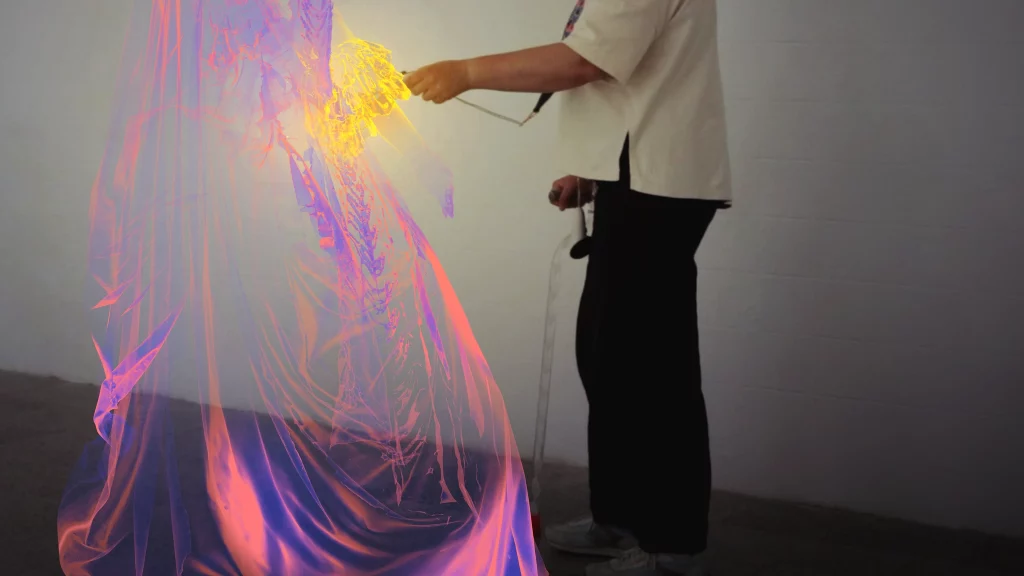
Feeling Virtual: An Archive of Touch
Iz Paehr (DE) A S+T+ARTS Ec(h)o Residency Project
___ + Networking: Town Hall Meetings
Wednesday 9. Sep | 17:00–18:00
Art & Culture as Innovation Drivers in AI Infrastructures
with Stella Diakou, PhD – Senior Researcher at T6 Ecosystems.
As AI becomes increasingly embedded in the infrastructures shaping our societies, what role can art and culture play in questioning, influencing and imagining these systems? This Town Hall explores how artistic and cultural practices can contribute to the development of AI infrastructures — bringing different perspectives into a conversation about the technological futures we are collectively building.
Friday 11. Sep | 12:00–13:00
The Next Chapter: Lessons Learned and Futures Beyond S+T+ARTS
with Masha Zolotova Head of European Collaboration at Ars Electronica.
What can we learn from almost ten years of S+T+ARTS? And how can the collaborations, methodologies and approaches developed through the initiative continue to inform new forms of art-driven innovation? This Town Hall brings the community together to reflect on what has been built and to consider where these ideas and practices can go next.
___ + Conference Days
Thursday 10. Sep | CONTESTED FUTURES | Europe Negotiating Power, Nature, Labour
ARCHIPELAGO OF POSSIBLE FUTURES Conference
Curated and hosted by Francesca Bria & José Luis de Vicente
10:00 | Welcome to Contested Futures · Opening remarks by Francesca Bria & José Luis de Vicente & Gerfried Stocker
I · POWER / NON-ALIGNED FUTURES
10:10–10:40 | Conversation: Strategic Autonomy — Quantum Science and the New Non-Alignment with Tommaso Calarco & Martin Rauchbauer
Quantum is where European scientific strength and European industrial dependency meet most sharply: the research base is world-class, the supply chains, capital and manufacturing are not. Tommaso Calarco, one of the architects of Europe’s quantum research programme, and Martin Rauchbauer, Austria’s first tech ambassador to Silicon Valley and founder of the Tech Diplomacy Network, ask whether Europe can act as a non-aligned power between the blocs — and what a science, arts and technology diplomacy of its own would actually require: which institutions, which budgets, which alliances.
10:40–11:00 | Keynote: Epic Fury: The Dark Art of Defense Tech with Simon Denny
Defence technology has acquired an aesthetic — sleek, heroic, unmistakably neo-Futurist — and that aesthetic does political work. Simon Denny, who has spent a decade taking apart the visual languages of extraction, crypto and corporate power, turns to Palantir, Anduril and their European imitators: how militarised AI is made to look both inevitable and desirable, who is flattered by that imagery, and what it keeps out of frame.
11:00–11:20 | Presentation: The Authoritarian Stack by Francesca Bria
Francesca Bria traces the rise of the authoritarian tech right in Silicon Valley and the alignment now consolidating around it: reactionary ideology, venture capital, defence and government contracts, and private platforms that have quietly become state infrastructure — cloud, identity, policing, borders. She calls it the Authoritarian Stack, and argues that Europe cannot regulate its way out of a dependency it has already accepted. What it needs is an industrial strategy for democratic infrastructure: public compute, open models, shared data, procurement that builds capacity at home rather than renting it from abroad, and the political will to fund it at scale.
11:20–11:40 | Performance–lecture: Mechanical Kurds by Hito Steyerl
Hito Steyerl, Professor of Emergent Digital Media at the Academy of Fine Arts Munich, won the S+T+ARTS Prize ’26 Grand Prize for Artistic Exploration with Mechanical Kurds. The title recalls the eighteenth-century automaton that appeared to play chess by itself while concealing a human operator, and the Amazon platform that later borrowed the name. In Erbil, Kurdish-Syrian refugees label military imagery through crowdsourcing platforms without knowing what it serves. The performance-lecture follows that circuit between digital labour, computer vision and political violence, and asks what responsible alternatives can be built.
11:40–12:20 | Panel: Soul or Arsenal? with Francesca Bria, Simon Denny and Hito Steyerl
European autonomy can turn in two directions: a public digital commons, or a militarised arsenal built with public money and held in private hands. The morning’s three speakers take the choice head-on, bringing together its political economy, its aesthetics and its geopolitics, and put the practical question to the room: which institutions, investments, imaginaries and alliances would make the first outcome real, and how much time is left to build them.
14:15–15:00 | Keynote: The Flows of Law, Technology and Empire Through Water and History with Radha D’Souza
The lecture will highlight how the entwinement of law and technology in the imperialist project plays out across bodies of water. Drawing on examples from different regions across the world, the lecture will provide insights into how colonialism and neocolonialism use law and technology as distinct techniques for the control and domination of waters and peoples.
II · LABOUR / EXTRACTION, REFUSAL & ALTERNATIVES
13:30–14:10 | Conversation: The Data Workers’ Inquiry: In Their Own Words with Julia Kloiber and Victoria De Napoli
AI systems rest on work that is deliberately kept out of view: labelling images, filtering violent content,
correcting and rating outputs — outsourced to the Global South and precarious almost everywhere.
Julia Kloiber speaks with Victoria De Napoli, writer, musician and researcher, part of the Data Workers’
Inquiry, who worked as a trainer for a technology company building AI systems and is making a
documentary about it. What the work does to the people who do it, and what rights, dignity and
organising look like from inside.
14:10–14:30 | Keynote: Eccentric Engineering: Building Otherwise with Tega Brain
Tega Brain is an artist and environmental engineer who builds working systems rather than critiques:
Solar Protocol, a network of volunteer-run solar servers where the sun decides which one serves the
internet; Asunder, a fictional artificial environmental manager that proposes what to sacrifice to keep
the planet within its limits; tools for refusing and obscuring personal data. Her keynote makes the case
for eccentric engineering based on minimal computing, good-enough prediction, infrastructure
designed for something other than growth and for climate art that points to the agency we still have.
14:30–15:00 |Conversation: What Alternatives? Power, Labour, Planet with Jaya Klara Brekke and Marina Otero Verzier, moderated by Julia Kloiber
From diagnosis to alternatives. Data centres are arriving in European regions faster than grids, water
systems and planning authorities can absorb them, and the public is rarely asked. This conversation
brings together the researchers, campaigners and builders working on the material footprint of AI and
on what could be built instead: public and cooperative infrastructure, ecological limits treated as design
constraints, global public goods, and computing within humanity’s limits rather than beyond them.
What already exists, who is building it, and what it would take to scale it in Europe ands beyond.
III · THE PLANET / PLANETARY GOVERNANCE
15:15–15:35 | Keynote: The Architecture of Public Truth with Eyal Weizman, Forensic Architecture
Forensic Architecture built a new evidentiary practice, using architecture, modelling and open-source
material to hold states and corporations to account where courts and media could not. Eyal Weizman
extends the method to the planet itself: the earth as a forensic object that registers pollution, ruin, environmental violence and genocide. The keynote asks what institutions such evidence demands if it is
to count, and who is entitled to produce public truth.
15:35–15:55 | Keynote: Children of a Modest Star: Governing Beyond the Nation-State with Nils Gilman (Berggruen Institute / Noema)
Planetary problems, national institutions: the mismatch defines the century. Nils Gilman, co-author of
Children of a Modest Star, argues that neither a world government nor the nation-state as we have it
can govern climate, pandemics or computation, and makes the case for multi-scale institutions built to
the shape of the problems themselves — a planetary politics that does not wait for consensus between
states.
15:55–16:15 | Artist Talk: The More-than-Human Laboratory by Agnes Meyer-Brandis
Agnes Meyer-Brandis won the S+T+ARTS Prize ’26 Grand Prize for Innovative Collaboration with the
Office for Tree Migration, a long-term project following how trees and plants move as climate zones
shift: north, uphill into the Californian White Mountains, into the peatlands. Her work sits between
scientific research, fieldwork and myth, building experiments that are at once rigorous and improbable.
The talk rehearses what it would mean to observe, design and govern from a position that is not
exclusively ours.
16:15–16:35 | Performance–lecture: Antimonuments by Rafael Lozano-Hemmer
For three decades Rafael Lozano-Hemmer has built participatory installations that turn public space
into a site of encounter and turn surveillance technology against itself: searchlights over Mexico City’s
Zócalo steered by participants online; shadows twenty metres high filled with the portraits of passers-
by; rooms that pulse with the recorded heartbeats of everyone who has entered them; biometric systems
put to work searching for the disappeared; bridges of light opening live voice channels across the
US–Mexico border. Surveying his entire body of work, from the early relational architecture pieces to
the antimonuments, he traces a practice concerned with memory, biometrics, participation and the
politics of who is seen, counted and remembered.
16:35–16:45 | Closing: Coexistence and Possible Futures with José Luis de Vicente
The day closes on the question it opened with: what did we negotiate, and which futures now feel
possible? A short reflection on coexistence across geographical and geopolitical blocs, and across the
divide between those who build these systems and those who carry their cost — and on what the day
leaves to be built as planetary alternatives for humanity.
Sunday 13. Sep
Negotiating with Water
As part of S+T+ARTS Aqua Motion, Negotiating with Water takes water as both a material reality and a cultural, political and geopolitical construct. Bringing together artists, theorists, Indigenous thinkers and legal experts, the programme questions dominant scientific, technological and colonial narratives around water and asks what other relationships with this vital element might be possible.
Rather than approaching water solely as a resource to be managed, the conference invites us to think with water — reconsidering hydro-social relations, imaginaries, rights and the forms of innovation and governance they might enable.
11:00 Welcome Words by Ana-Maria Carabelea
11:05–11:35 | Talk: An Indigenous Ontology of Water with Deborah McGregor
For thousands of years, Indigenous peoples have created and passed on knowledge resulting in sustainable relationships with all of Creation. Along with knowledge comes the responsibility to maintain our relationships with water. In this lecture, Deborah McGregor shares Anishinaabe perspectives and knowledge relating to how water is understood, conceptualized and related to. Referring to Anishinaabe legal traditions that guide how humans can co-exist with water, Deborah reflects upon her own 25+ years of research and community-based experience in the area of Indigenous water governance.
11:35–12:05 | Talk: Water through a Legal Lens: From Private Commodity to the Heritage of Mankind with Stefano Burchi
Stefano Burchi’s talk unpacks the evolving legal conceptions of (fresh)water, from water as a private commodity to water as public property regulated by nation-states through national water laws, all the way to the water of boundary rivers, lakes and aquifers framed in treaties and agreements between multiple nation-states. These legal conceptions illustrate how nation-states and, more broadly, humans and societies relate to water. Against this backdrop, the talk raises questions about the possibilities to upscale the legal discourse about water from the level of individuals, communities and nation-states
acting in their self-interest to a global level, where water is regarded as the heritage of mankind, governed by norms that appeal universally and (ideally) emanate from (and are administered by) a supranational authority.
12:05–12:30 | Q&A with Deborah McGregor and Stefano Burchi
Deborah McGregor and Stefano Burchi answer the audience’s questions in a joint Q&A that connects Anishinaabe legal traditions with national and transnational legal frameworks.
12:30–13:15 | Panel: Fluid Media with Ioana Vreme Moser, Robertina Šebjanič and Jamie Allen
What if instead of a distant, unknown territory, we understood bodies of water as media that carry messages about hydro social relations? Water has specific ways of sensing, recording and storing traces of military, logistic, industrial or commercial activities–from chemical weapons dumped on the ocean floor, to sunk ships that once transported goods across the globe, or the invisible toxic traces left by industrial activities. This panel discussion brings together artists Ioana Vreme Moser, Robertina Šebjanič, Jamie Allen to discuss how their practices become a form of listening to and surfacing (as translating)
underwater stories about humanity’s use and abuse of waters.
13:45–14:15 | Panel: Art for the Hydrocommons with Laura Colmenares Guerra and Seila Fernández Arconada
The hydrocommons is understood as the complex connections and permeations between human and non-human bodies of water. It does away with the illusory separation between the two and invites a reimaging of their relations outside capitalist or colonial frames. Bringing together artists Laura Colmenares Guerra and Seila Fernández Arconada–
whose past work focuses on the world’s largest river by volume, the Amazon–, the discussion unpacks how the notion of the hydrocommons is activated in artistic practices both to question water imaginaries that perpetuate injustice and reimagine hydro-social relations.
14:15–15:00 | Keynote: The Flows of Law, Technology and Empire Through Water and History with Radha D’Souza
The lecture will highlight how the entwinement of law and technology in the imperialist project plays out across bodies of water. Drawing on examples from different regions across the world, the lecture will provide insights into how colonialism and neocolonialism use law and technology as distinct techniques for the control and domination of waters and peoples.